
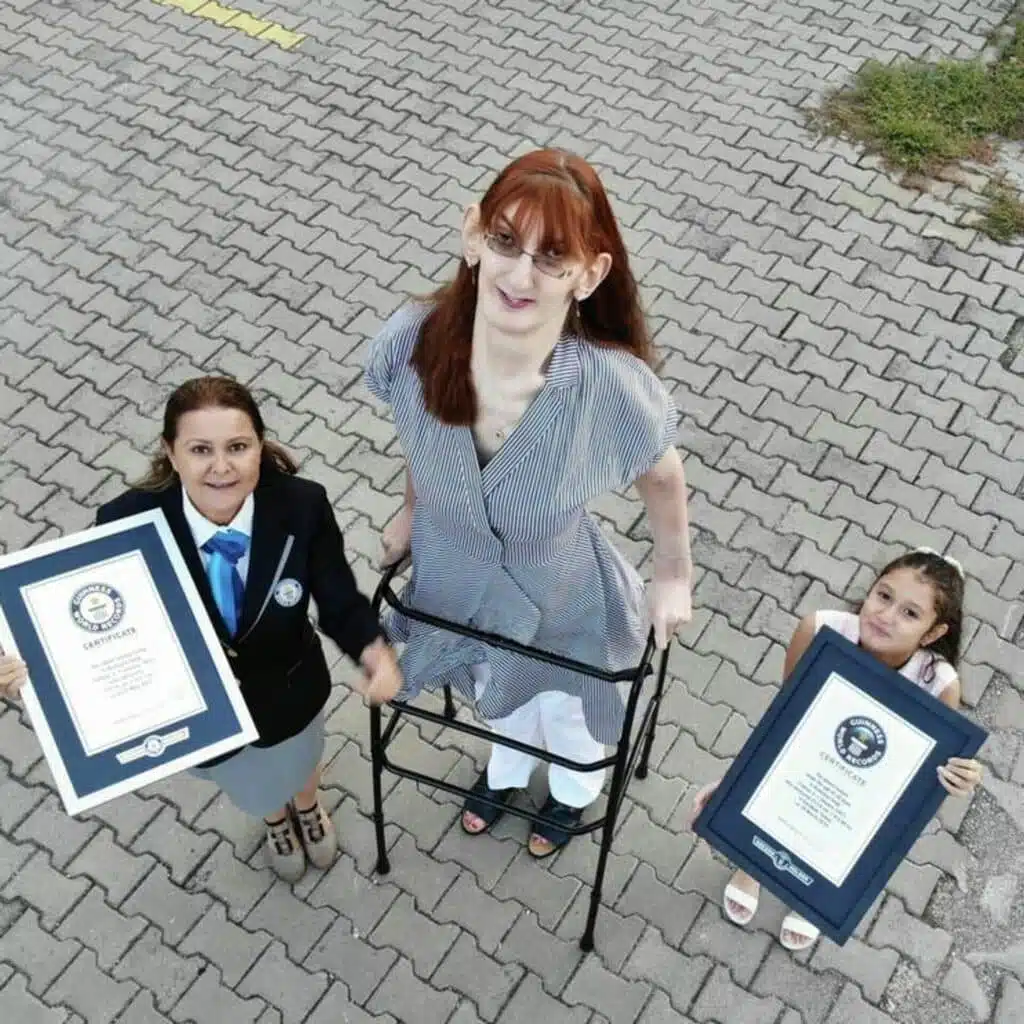
Rumeysa Gelgi is 215.16 cm tall, which is 7 ft 0.7 in, and she has held the Guinness World Records title of tallest woman living since 2021. She is also a web developer, a crime fiction reader, and the holder of seven other records, which is six more than most accounts of her life mention.
This article does three things the usual profile does not. It lists all eight titles with their measurements, because the figure of five is now four years out of date. It looks at the numbers around her condition, which contradict each other badly depending on who you ask. And it covers her one British appearance, an afternoon at the Savoy with the shortest woman in the world, which is also the clearest thing on record about what her height actually involves.
How tall is she, and who measured her
215.16 cm, published to two decimal places. Guinness has not released the measurement protocol used on her, so we cannot tell you who held the stadiometer, but the precision of the published figure is the point: a record this close to the limit of human stature is not reported to the nearest centimetre.
She was confirmed as the tallest living woman in 2021, aged 24. She had already held the title of tallest living teenage girl since July 2014, when she was seventeen and measured 213.6 cm. That earlier figure is widely given as 2.13 m, which rounds away 6 mm; the record entry says 213.6.
For context on where that sits: the tallest woman ever recorded was Zeng Jinlian of China, at 246.3 cm, who died in 1982 at eighteen. Gelgi is 31 cm short of that, and she is not going to approach it. The tallest living man, Sultan Kösen, whose height has been measured and remeasured, is 251 cm, 36 cm taller than her, and also Turkish.
Eight records, not five
Every version of this article until now, including ours, said five. In July 2024 Guinness announced two more, and a careful read of the full list gives eight. Here they are with the measurements as the record entries give them.
| Record | Measurement | Held since |
|---|---|---|
| Tallest woman living | 215.16 cm, 7 ft 0.7 in | 2021 |
| Tallest teenager living, female | 213.6 cm | July 2014 |
| Largest hands on a living person, female | right 24.93 cm, left 24.26 cm | 2022 |
| Widest hand span on a living person, female | 22.6 cm, 8.9 in | 2022 |
| Longest finger on a living person, female | 11.2 cm, 4.40 in | 2022 |
| Longest back on a living person, female | 59.90 cm, 23.58 in | 2022 |
| Longest ears on a person, female | 9.58 cm average, 3.77 in | July 2024 |
| Longest baby, female | 59 cm at birth, 1 January 1997 | July 2024, shared with her mother |
Two of those need explaining.
The longest baby record is held jointly with her mother, Safiye Şahin Gelgi, which is a category Guinness uses when a birth measurement belongs to both parties. Rumeysa was 59 cm at birth, which is roughly the length of an average three-month-old. The male equivalent is a far older entry: a child known as Babe, born to Anna Bates in Canada in January 1879 at 71.12 cm, who lived eleven hours.
The longest ears record is the one she has spoken about most pointedly. She was told, she says, to have cosmetic surgery to fix her ears, though she never needed it. Collecting a world record for them instead is a fair answer.
Our earlier version also listed her back at 59 cm. The record entry says 59.90 cm, which is 9 mm more, and we have corrected it.
The London afternoon
This is the part of her story with a British address, and it happened at the Savoy.
On Guinness World Records Day 2024, Gelgi came to London for the first time and took afternoon tea with Jyoti Amge of India, who at 62.8 cm is the shortest woman in the world. The two were inducted as Guinness World Records icons in the book’s seventieth anniversary edition. Gelgi received her certificate from Craig Glenday, the editor-in-chief.
She is 2.15 m. Amge is 0.63 m. The difference is 1.52 m, which is more than Amge’s full height twice over. Gelgi’s account of the afternoon is characteristically practical: eye contact was difficult at points, and they found they had make-up, nail care and self-care in common. Amge said Gelgi was good-natured and that she felt comfortable talking to her.
It is worth noting why London and not somewhere else. Guinness World Records is a London company. Sir Hugh Beaver of the Guinness brewery commissioned the first book in 1954 after losing a pub argument he could not settle, the twin brothers Norris and Ross McWhirter compiled it from two rooms above Fleet Street, and the company’s registered office is still in the City of London today. Every record on the table above was granted from a building about a mile from the hotel where she had her tea.
She called the trip one of the highlights of her year, and said she wanted to visit more countries and landmarks. Her first journey abroad had been in 2022, to the United States, to film a documentary.
Weaver syndrome, and the numbers that do not agree
Gelgi’s height is the result of Weaver syndrome, a genetic overgrowth condition first described in 1974 by the American physician David Weaver. It is caused in most cases by a mutation in the EZH2 gene on chromosome 7q36, identified in 2011. A small number of cases involve NSD1 instead. It is autosomal dominant, and most cases are sporadic, arising new in the individual with no family history.
It produces rapid growth before and after birth, advanced bone age, distinctive facial features, limb and finger differences, and in many cases developmental delay, poor coordination and balance, speech delay and abnormal muscle tone. For Gelgi it has meant numerous operations in childhood and limited mobility. She can stand and walk, but it is uncomfortable, and she uses a wheelchair and a walking frame.
Now the part where this article has to disagree with itself. How rare is it? Three answers are in circulation, and they are not close.
- Twenty-seven diagnosed people worldwide. This is the figure in every popular account, including our earlier version, which stated that Gelgi was only the 27th person ever diagnosed. We can no longer find a current source for it.
- Forty-eight documented and confirmed cases, with a prevalence estimate of about one in 15,000 drawn from a 2012 study. Those two figures are themselves hard to reconcile: one in 15,000 would imply thousands of undiagnosed people in Britain alone.
- Around 100 to 150 cases reported worldwide, which is the figure on Gelgi’s own website.
The honest conclusion is that nobody knows, and that the spread tells you something real: an overgrowth syndrome with variable severity is diagnosed when somebody thinks to test for it, which for most of its history meant the obvious cases only. The figure of 27 should be treated as a snapshot from an earlier decade rather than a fact. We have removed it from this article.
She never attended a conventional school because of her condition, and studied through educational programmes at home, which is how she qualified in web development. She swims to maintain strength, which is the usual recommendation for a body under this much mechanical load. On that last point, our piece on the best sports for tall people, and why height helps in them goes through why water takes the joints out of the equation.
What the height costs, day to day
The record list is the glamorous part. The logistics are the real story, and the clearest documented example is a flight.
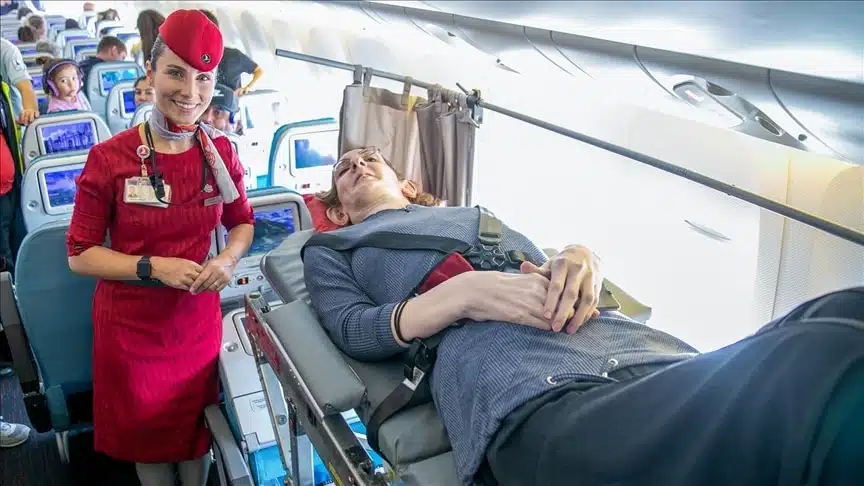
On 28 September 2022, Gelgi flew for the first time in her life, from Istanbul to San Francisco. Turkish Airlines fitted a stretcher across six economy seats spanning three rows so that she could travel lying down. Note the wording, because most accounts including ours get it slightly wrong: the seats were not removed, a stretcher was installed over them. The distinction matters because it is the standard medical-transport arrangement rather than a one-off favour, and because it is the only way a 2.15 m frame makes a twelve-hour flight.
Everything else follows the same pattern, and British houses make the point better than most. The typical internal door in England and Wales is 1,981 mm tall, which is 6 ft 6 in. Gelgi is 215.16 cm. She would have to duck by 17 cm to get through an ordinary English doorway. Scottish and continental metric doors are 2,040 mm, which still leaves her 11 cm short of upright. There is no building standard anywhere in Britain that would let her walk through a door without bending.
Nothing else fits off the shelf either. For British readers running into the same wall at a lower altitude, we keep a page on large size shoes by international sizes, and the conversions there are the argument for why nobody should quote a single number: the scales genuinely disagree with each other.

Britain’s own tallest woman, and why nobody knows her name
Gelgi is the tallest woman alive. The tallest woman Britain has produced was Jane Bunford, and she was taller than Gelgi by 26 cm.
Bunford was born in 1895 at Bartley Green, on the western edge of Birmingham. She fractured her skull falling off a bicycle at eleven, which is presumed to have damaged her pituitary gland, and she grew from there. She was measured at 2.39 m on her twenty-first birthday in 1916, with 2.41 m the figure adjusted for the curvature of her spine. She held the tallest woman ever title for sixty years, until Zeng Jinlian passed her, and she remains the tallest British person on record of either sex. Her auburn hair reached her ankles in two plaits and earned her a separate entry in the 1972 Guinness book.
She died in 1922, aged 26, of hyperpituitarism and gigantism. Then the story turns. Her coffin was reportedly carried without her in it, the pallbearers noticing it was far too light. A skeleton listed in the 1971 Guinness book as an unidentified tallest giantess was displayed at the University of Birmingham, and was later identified as hers. The university has never explained how it obtained the remains. Her relatives reclaimed them in 2005 and gave her a second, private funeral with no headstone. Whether the family sold the body or it was taken without permission is still unknown.
The two lives make an unintended argument. A hundred years apart, in Birmingham and in Karabük, the same mechanism produced two extraordinary women. One of them spent eighty-three years in a cabinet as an exhibit with no name. The other has eight world records, a documentary, a website, and complete control of how she is described.
What she says about it
She uses the attention deliberately, to raise awareness of Weaver syndrome, a condition most doctors will never see a case of, and to argue for acceptance of visible difference. Her most repeated line is the one from her earlier interviews:
Every disadvantage can become an advantage for you, so accept yourself as you are, be aware of your potential and do your best.
She has been more direct elsewhere. Asked whether she would change her condition if she could, she answered that she could not say yes, because without the challenges she would not be who she is. And on the pressure to correct herself cosmetically, she said that she was told to have surgery to fix her ears even though she never needed to.
Her stated aim with Amge after the London tea was to encourage people with visible differences to be seen rather than hidden, and to make the point that being different is all right. On a day organised by a records company whose historical business model was precisely the opposite, two women who had every reason to resent the attention turned it into something useful.
Where to find her
She maintains a blog at rumeysagelgi.com, which includes her own explainer on Weaver syndrome, and she is active on Instagram, Facebook, X and LinkedIn as @rumeysagelgi.
Related reading on Wetall: Zhang Ziyu, how tall she really is and whether her game can catch up, and the ten tallest men of all time, and the British giants the ranking leaves out.
Sources
- Guinness World Records, “Longest baby to tallest woman: Rumeysa’s message of self-love as she breaks new records”, 9 July 2024, for the count of eight titles, the measurements of all eight records, the birth length of 59 cm on 1 January 1997, her mother’s name, the comparison with Anna Bates’s son, and her quotations on her ears and on her condition.
- Guinness World Records, “Rumeysa Gelgi: the tallest woman in the world”, for the 2021 confirmation, the teenage record of 213.6 cm at seventeen, the 2024 icon induction and the documentary.
- Euronews, “The world’s tallest and shortest women meet in London”, 21 November 2024, for the Savoy, Guinness World Records Day 2024, Jyoti Amge at 62.8 cm, the seventieth anniversary edition and what each woman said.
- Guinness World Records, “Tallest woman Rumeysa Gelgi shares plans to see the world after whirlwind trip to London”, January 2025, for the first visit to the UK, the certificate from Craig Glenday and her 2022 trip to the United States.
- Reference entry on Rumeysa Gelgi, for her birth on 1 January 1997, her home in Karabük province, the flight of 28 September 2022 from Istanbul to San Francisco, the stretcher across six seats in three rows, and the dates attached to each record.
- Reference entry on Weaver syndrome, for David Weaver’s 1974 description, the EZH2 gene on 7q36 identified in 2011, the NSD1 involvement, autosomal dominant inheritance, the clinical features, the figure of 48 documented cases and the prevalence estimate of about one in 15,000 from a 2012 study.
- Rumeysa Gelgi’s own page on Weaver syndrome, for the figure of around 100 to 150 cases reported worldwide, which contradicts the figure above.
- Guinness World Records, on Jane Bunford, July 2024, for her estimated 2.41 m, the 2.39 m measurement of 1916, the bicycle accident, the sixty-year reign, the hair record in the 1972 edition, her death certificate, the light coffin, the skeleton at the University of Birmingham and the reclamation in 2005.
- Guinness World Records, “A history of the world’s tallest people”, December 2024, for Zeng Jinlian at 246.3 cm and Sultan Kösen at 251 cm.
- Guinness World Records, “Our history”, for Sir Hugh Beaver, the 1954 commission, the McWhirter twins above Fleet Street and the registered office in the City of London.
- Howarth Timber, UK door sizes, for the typical internal door height of 1,981 mm in England and Wales and 2,040 mm in Scotland and on the continent.