
Jérémy Gohier turned sixteen on 5 November 2026, which means the record this article was written about has quietly lapsed. He is not the world’s tallest pre-teen any more, for the straightforward reason that nobody is a pre-teen at sixteen. What he is instead is 7ft 6in, the tallest player at the 2026 under-17 World Cup, signed to a French professional club and represented by the agency that developed Victor Wembanyama.
The earlier version of this article was 1,600 characters long, predicted that he would join an American programme and reach the NBA around 2030, and gave his height as 221 cm. All three of those have been overtaken. This is the current position, with the figures sourced, including the ones that disagree with each other.
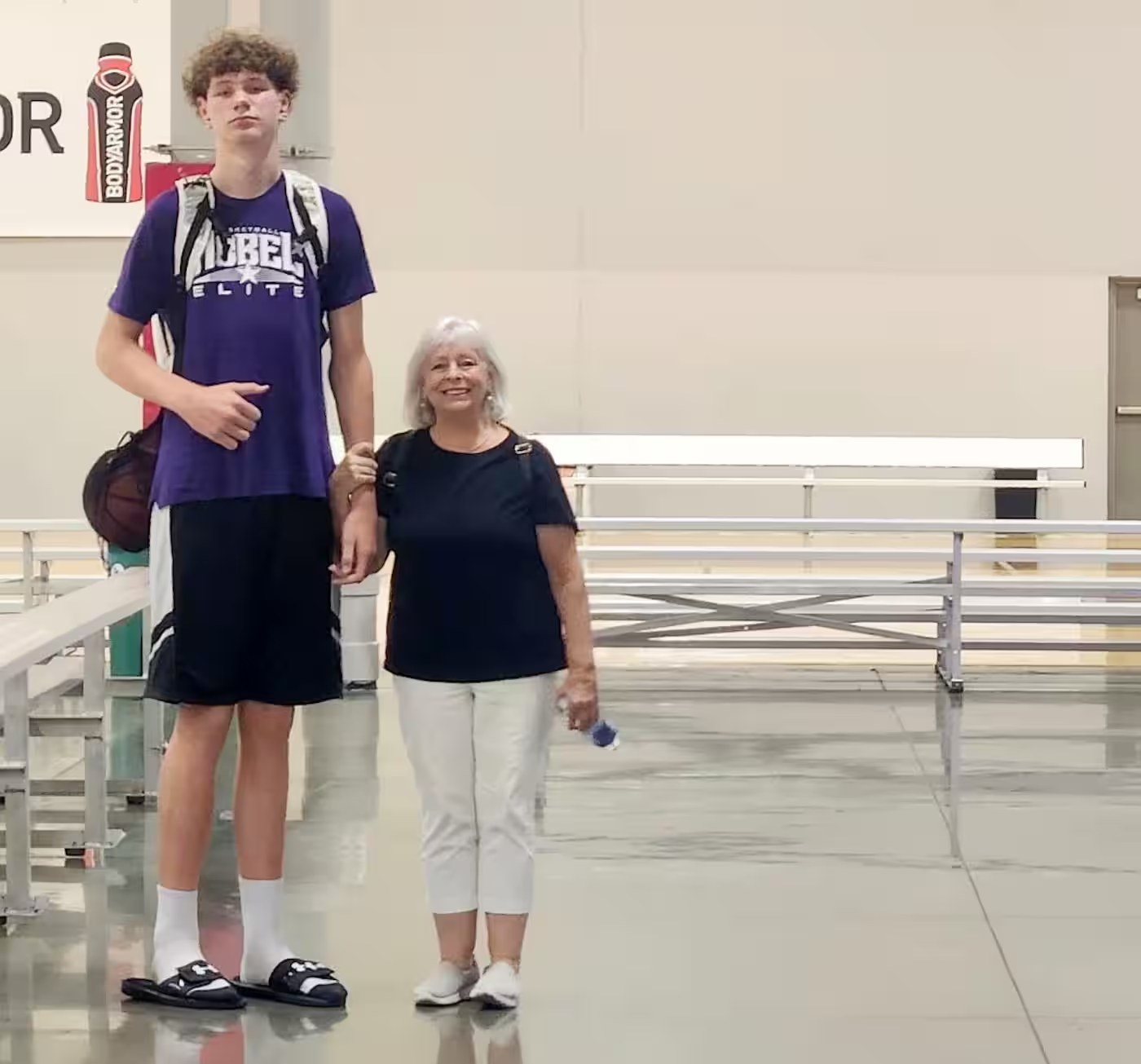
How tall is Jérémy Gohier?
His FIBA player profile lists him at 229 cm, 7ft 6in, and FIBA named him the tallest player at the under-17 World Cup in Istanbul in the summer of 2026 on that figure.
He gives a different number himself. In July 2026 he said he was 7ft 5in in shoes, with a 7ft 6in wingspan, and that he had stopped growing. That is an unusual direction for a contradiction to run: the player is quoting himself shorter than the governing body lists him. The likeliest explanation is that the two figures are measuring different things, barefoot against shod, or that one of them is simply old. We print both rather than pick.
The progression on record runs roughly like this: 7ft 3in, or 221 cm, when the clips from the American Middle School Hoops Camp went round in September 2024 and he was thirteen; 7ft 4in in a Canadian television report in March 2025, at fourteen; and 7ft 6in on his FIBA profile now. If his own statement that he has finished growing is right, 7ft 6in is where he settles. That is roughly fifty centimetres above the modelled average for a fully grown British man, which the NCD Risk Factor Collaboration put at 178.2 cm for British nineteen-year-olds in its 2019 data. We set out how that figure is arrived at, and how it differs from the survey average, in which country has the tallest average height, and where Britain sits.
One British note on that comparison, because it is a gap in our own national data rather than a fact about him. England has exactly one national height measurement programme, the National Child Measurement Programme, and it measures children twice: in reception, at four and five, and in year 6, at ten and eleven. It does not measure secondary-school pupils at all. So there is no official English mean height for a thirteen-year-old or a sixteen-year-old boy to set him against, and anyone who gives you one is using a modelled figure or a growth chart rather than a survey. The earlier version of this article said he was 61 cm above the average Canadian thirteen-year-old without saying where that average came from, and we have dropped it for that reason.
Where he is from
Gohier was born on 5 November 2010 and grew up in Laval, Quebec. He was enrolled in the sport-study programme at École Georges-Vanier in Laval and held a Petro-Canada FACE scholarship, which supports young athletes. He started playing at six. He has said he shot hoops with his mother every day as a child. His coach in Quebec was Daniel Mulumba.
What he has actually played
This is the part the earlier version of this article did not have, because none of it had happened yet. Two tournaments for Canada, both of them against older players.
| Year | Competition | Games | Points per game | Rebounds per game |
|---|---|---|---|---|
| 2025 | FIBA U16 AmeriCup | 6 | 2.5 | 4.3 |
| 2026 | FIBA U17 World Cup, Istanbul, 27 June to 5 July | 7 | 2.4 | 3.6 |
At the under-16 AmeriCup in 2025 he was one of the youngest players in the competition, having turned fourteen only the previous November. At the under-17 World Cup a year later he played 11.1 minutes a game for almost identical output, and FIBA had him as the tallest player in the tournament.
Those are not spectacular numbers and they should not be read as a verdict. A fourteen or fifteen year old playing eleven minutes a night against the best sixteen year olds in the world is being given experience rather than a role. But they are the only competitive figures that exist for him, they come from the governing body rather than from a highlight reel, and any article that tells you he is the next Wembanyama without printing them is selling you something.
Nanterre 92, not an American college
Here is the single biggest change since this article was written, and it goes in the opposite direction to what it predicted.
In April 2026 Gohier signed with Comsport, the agency that handled Wembanyama’s development. By July 2026 he had signed with Nanterre 92 in France and was expected to play for the club’s under-18 and under-21 sides in 2026-27. He has said he has had invitations from major American programmes, and there has been talk of a place in an Adidas Next Generation EuroLeague squad, which was unconfirmed when we last checked.
So the route is European club basketball, not an American sport-study programme followed by a university followed by the draft. That matters beyond his own career, because it is the same decision British prospects have increasingly been making. The NCAA pathway was the default for a British teenager with professional ambitions for about thirty years. A French club contract at fifteen is a different bet: less exposure, more coaching, and a professional environment several years earlier.
What he has added, and what the people around him say
He says he put on about 40lb of muscle in the year to summer 2026 and improved his shooting. His agent, Jérémy Medjana, puts him roughly 40 kg heavier than Wembanyama was at the same age, and says he has considerable potential while explicitly declining to call him the next Wembanyama, on the grounds that the two are different players.
Gohier’s own assessment of that comparison is more candid than most sixteen year olds would manage in public. He says Wembanyama has the same mobility but is stronger, that he keeps a private competition with him in his head, and then: “I don’t do anything better than him. He does everything better than me.” He has also said what he wants to be, which is not what you would expect from a man of his height: “I want to be the best small forward.”
That ambition is the thing worth watching. A 7ft 6in player who wants to play on the perimeter is either mistaken about himself or genuinely unusual, and the specialist coverage has noted that he handles the ball and takes step-back jump shots, which almost nobody at that height does.
How he compares with the other giants of his age
At thirteen, standing 7ft 3in, he was taller than both the tallest man and the tallest woman on record were at the same age. Zeng Jinlian measured 2.17 m at thirteen and Robert Wadlow 2.18 m. Victor Wembanyama was 2.03 m at the same age.
That comparison needs one qualification that the earlier version of this article did not make. Wadlow and Zeng both had pituitary disorders and neither stopped growing; Wadlow reached 2.72 m and Zeng 2.48 m. Gohier, on his own account, has stopped. Being taller than they were at thirteen is a fact about thirteen-year-olds, not a forecast.
Among players rather than record-holders, Canada’s current crop is the useful comparison. Zach Edey, from Toronto and four years older, is listed at 7ft 3in or 2.21 m depending on the source and now plays for the Memphis Grizzlies after going ninth in the 2024 draft. Olivier Rioux, from Terrebonne, is 7ft 9in, became the tallest player ever to appear in a college game in November 2025, played seventeen minutes across that whole season and has since transferred from Florida to UC Irvine. Rioux is the cautionary half of the Quebec story and Edey is the encouraging half, and Gohier sits between them in height and well behind both in age.
On the women’s side, the equivalent case is Zhang Ziyu, whose listed height and whose actual game have been pulling in different directions in much the same way.
Why Britain does not have one of these
The honest answer is that it probably does, and we would not necessarily know.
Britain’s tallest men have repeatedly turned out to be basketball players: Neil Fingleton at 7ft 7in and Paul Sturgess at 7ft 7.26in both went through the American college system in their late teens, and neither reached the NBA. But there is no British equivalent of the Quebec pipeline that found Gohier at thirteen, put him in a sport-study programme, funded him through a national scholarship, and had an agency on him by fifteen. There is also, as above, no national measurement of British teenagers after the age of eleven, so a 7ft fourteen-year-old in Britain is found by a scout or not found at all.
That is a structural point rather than a complaint about talent. Our round-up of the tallest basketball players ever and Britain’s giants goes through what has happened to the British players who did get found, including the current state of the domestic league they mostly ended up in.
What to watch next
Three things, in order of how much they will tell you. Whether he gets senior minutes at Nanterre rather than under-21 minutes. Whether his output at Canada’s age-group tournaments rises as he fills out, because Rioux’s fell. And whether the small forward ambition survives contact with professional coaching, because the easiest thing in the world for a club to do with a 7ft 6in sixteen-year-old is to park him under the basket and leave him there.
His Instagram account is @jaygohier.
Sources
- FIBA player profile, for his date of birth, the 229 cm listing and the full tournament statistics.
- FIBA, for his ranking as the tallest player at the 2026 under-17 World Cup and the tournament dates.
- Taking the Charge, 10 July 2026, for the Nanterre 92 signing, the Comsport agency, his own height and wingspan figures, the 40lb of muscle, his agent’s comments and the quotations.
- Global News, March 2025, for the 7ft 4in figure at fourteen, his coach, and the interest from the United States, Europe and Russia.
- National Child Measurement Programme operational guidance, for the fact that England measures children’s height only in reception and year 6.
- NCD Risk Factor Collaboration, for the modelled 178.2 cm average height of British nineteen-year-old men in the 2019 data.
- Olivier Rioux and Zach Edey, for the Quebec and Canadian comparisons.
- Neil Fingleton and Paul Sturgess, for the British heights and careers.