
There is a family in Minnesota whose five members average 6 ft 8 in, and Guinness World Records has the paperwork to prove it. The figures are solid, which is more than can be said for most height records. What is not solid is the word in the middle of the record title, because “tallest family in the world” turns out to describe a category rather than a fact.
So this piece does two things. It sets out exactly what was measured, by whom and when, and corrects a comparison about tennis courts that has followed the story around for years. Then it looks at why a family like this is so rare, using a set of British numbers from 1886 that still explain it better than anything since, and at the household in east London that comes closest to matching them.
The record, precisely as it stands
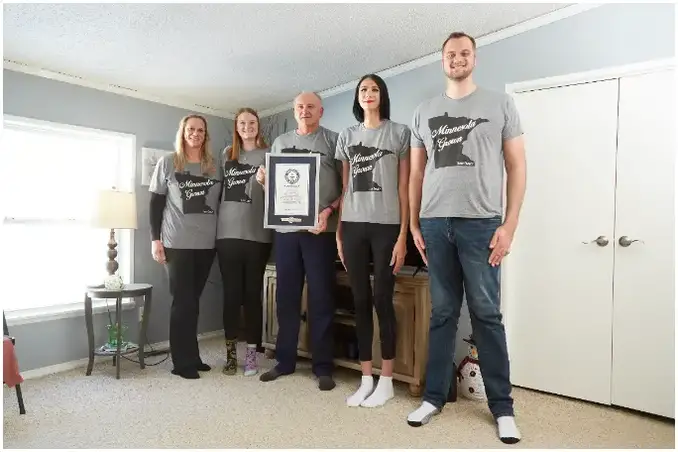
The holders are Scott Trapp, Kristine Trapp, Savanna Trapp-Blanchfield, Molly Steede and Adam Trapp, all of the United States. The family home is in Esko, a small town in north-eastern Minnesota. The record title is simply “Tallest family”, and the result Guinness publishes is an average height of 203.29 cm, or 6 ft 8.03 in, achieved on 6 December 2020 in Duluth, Minnesota.
| Family member | Height | Height (cm) |
|---|---|---|
| Adam Trapp, son | 7 ft 3 in | 221.71 |
| Savanna Trapp-Blanchfield, daughter | 6 ft 8 in | 203.60 |
| Scott Trapp, father | 6 ft 8 in | 202.70 |
| Molly Steede, daughter | 6 ft 6 in | 197.26 |
| Krissy Trapp, mother | 6 ft 3 in | 191.20 |
Note the ordering. The tallest person in this family is not the father. Adam, who was 22 when the family was measured, is 19 cm taller than Scott and 30.5 cm taller than Krissy. Savanna, the elder daughter, is nine millimetres taller than her father. Krissy is the shortest of the five at 6 ft 3 in, which in almost any other household would make her remarkable.
Who did the measuring
The family was measured in December 2020 by Dr Anna Sudoh, an orthopaedics doctor at Essentia Health in Duluth. Guinness’s own account confirms that the family met the criteria for the title, but it does not publish the measuring protocol, so the frequently repeated detail that each member was measured three times across a day, standing and lying down, is not something Guinness itself states. The photographs released with the record do show Adam measured standing against a wall and Molly measured lying on the floor, which at least matches the description.
One date is worth untangling, because the story is usually told wrongly. The record is dated 6 December 2020, but Guinness did not publish the news until 13 April 2022, and local coverage broke in February of that year. So the family held the title for well over a year before most people heard about it. Saying that they were “named the world’s tallest family on 6 December 2020” conflates the measurement with the announcement.
The tennis court claim does not survive arithmetic
Add the five heights together and you get 1,016.47 cm, which is 10.16 m. The comparison attached to that figure almost everywhere is that it equals half a tennis court. It does not.
A tennis court is 23.77 m long, so half of it is 11.89 m. The Trapps laid end to end reach 10.16 m, which is about 85 per cent of half a court. Close enough for a headline, not close enough to print as a fact.
Two comparisons that do work, and that will mean more to a British reader:
- A cricket pitch measures 22 yards, or 20.12 m, between the wickets. The five Trapps laid end to end cover just over half of it.
- A football crossbar is 8 ft from the ground, which is 2.44 m. Adam Trapp, at 2.22 m, stands 22 cm below it. He could stand under the bar in his boots and not have to duck.
“Tallest family” depends entirely on how many people you count
Here is the catch in the record, and it is not a criticism of Guinness so much as a consequence of how categories work.
Guinness also keeps a record for the tallest married couple living. It is held by Sun Mingming and Xu Yan of China, at 236.17 cm and 187.3 cm respectively, a combined 423.47 cm. Their average height is 211.74 cm. That is 8.4 cm more than the Trapp family average.
A married couple is, by most definitions, a family. If the categories were merged, the Trapps would not hold the title. They hold it because “tallest family” is in practice a record for households of three or more, judged on the mean, and because adding members to a family almost always pulls the average down. Every extra person has to clear roughly 2 m to help rather than hurt. A family of five at this average is a far harder achievement than a couple at a higher one, which is exactly why the two categories are kept apart. It also means the record’s name promises more than the record delivers.
Dates are shaky even in the couple category. Guinness’s own page for Sun and Xu gives 4 August 2013 in its summary, which is their wedding date, while the body of the same page says they were measured in Beijing on 14 November 2013. We have no way of resolving that and neither, apparently, does Guinness. If you are interested in how this category has changed hands, our piece on the tallest couples in history traces it further back.

Britain’s closest household is in Dagenham
Britain has never had a verified tallest family, but it has had the household that comes nearest, and it is not in a mansion.
Wilco and Keisha van Kleef-Bolton live in Dagenham, east London. Guinness recognised them as the tallest living married couple, and the figures on record give Wilco at 210 cm, or 6 ft 11 in, with the couple’s combined height at 404.7 cm, measured at their home in England on 18 March 2009. That puts their average at 202.35 cm, which is within a centimetre of the Trapp family average.
The figures then start to disagree with each other, and it is worth saying so rather than picking the tidiest version:
- A Daily Mail feature of 21 July 2012 gave Wilco at 7 ft, which is 213 cm, and Keisha at 6 ft 5 in. That is three centimetres taller for Wilco than the Guinness figure, and the article reported Keisha’s own view that Guinness had measured him too low.
- The same article dated their Guinness title to 2001, while the record itself is dated March 2009 and the public announcement came in 2010. Three dates circulate for one record.
- By 2012 the title had passed to Wayne and Laurie Hallquist of the United States, and it has since passed to Sun and Xu. The Dagenham record is a historical one.
The family detail is the interesting part for anyone following inherited height. In July 2012 the Daily Mail recorded three children: Lucas, then six, at 4 ft 5 in; Eva, then four, at 3 ft 7 in; and Jonah, six weeks old, just under 2 ft. Reference entries on the couple now refer to five children. The eldest of them will be an adult by now, and nobody appears to have measured any of them since. If a British family is ever going to take this record, the material is in a two-bedroom house in Dagenham and no one is watching.
Why families like this are so rare: the British numbers from 1886
The reason tall parents do not reliably produce taller children was worked out in Britain, on British families, 140 years ago.
Francis Galton published “Regression Towards Mediocrity in Hereditary Stature” in the Journal of the Anthropological Institute in 1886. He had collected the heights of 205 sets of parents and 930 of their adult children, and he found something that still holds. A child’s deviation from the population average tends to be about two thirds of the parents’ combined deviation. Galton put the point of convergence at 68¼ inches, roughly 173 cm, and calculated an average loss of a little over 0.6 inch per generation. Run it backwards and the effect is stronger still: for any given tall child, the most likely parental deviation is only about a third of the child’s.
In plain terms, very tall parents usually have children who are taller than average and shorter than themselves. That is the default. The Trapps did the opposite, in all three cases.
You can put numbers on how unusual that is, using the mid-parental rule that paediatric growth clinics still use. For a boy, the predicted adult height is the father’s height plus the mother’s height plus 13 cm, divided by two. For a girl it is the father’s height minus 13 cm, plus the mother’s height, divided by two. The likely range runs 8.5 cm either side of that figure, which is about two standard deviations.
| Child | Predicted height | Likely range | Actual height |
|---|---|---|---|
| Adam | 203.45 cm | 194.95 to 211.95 cm | 221.71 cm |
| Savanna | 190.45 cm | 181.95 to 198.95 cm | 203.60 cm |
| Molly | 190.45 cm | 181.95 to 198.95 cm | 197.26 cm |
Adam finished 9.8 cm above the top of his predicted range and 18.3 cm above the prediction itself. Savanna finished 4.7 cm above the top of hers. Molly came in inside the range, near its upper edge. Two of the three children exceeded a bound that is meant to catch roughly 95 per cent of outcomes.
That is what makes this family a genuine outlier rather than simply a tall one. It is not that the parents are tall, though they are. It is that the regression Galton described did not happen.

Living in a house built for other people
The sporting side of the story is the easy part. All three Trapp children played volleyball or basketball, which is where bodies of this size are an advantage and where you would expect them to end up. Our round-up of the sports that suit tall people explains why those two in particular, and our piece on the tallest basketball players in the world covers the upper end of it.
The harder part is everything else, and it is multiplied by five in a household like this. Standard British internal doorways are 1.98 m, which Adam Trapp cannot walk through without stooping. A standard double bed is 1.9 m long. Kitchen worktops sit at 90 cm, which is a long way to bend down to when you are over 2 m tall. Car headroom is the one most tall people mention first, and it is covered in our guide to cars with room for tall drivers.
None of these are hardships in the serious sense. They are a constant low-level tax on the day, and the point about this family is that there is nobody in the house for whom the house works.
So who is the tallest family in the world?
On the record as it stands, the Trapps of Esko, Minnesota, at an average of 203.29 cm across five people, measured on 6 December 2020. That answer is correct and it is properly sourced, which puts it ahead of most claims in this field.
It is also narrower than it sounds. It means the tallest verified household of three or more, judged on the mean, among the families who applied. Taller families may well exist and simply have not written to Guinness. A couple with a higher average already holds a different record. And the reason the Trapps are interesting is not the average at all, it is Adam, who ended up almost 10 cm beyond the range his parents’ heights predicted.
If you want the heights that are measured most carefully of all, those belong to individuals rather than families, and our list of the tallest men of all time is the place to start.
Sources
- Tallest family, Guinness World Records, record 15-91951. Average height 203.29 cm, 6 December 2020, Duluth, Minnesota.
- Minnesota family confirmed as tallest in the world, Guinness World Records, 13 April 2022. Individual heights and the measurement by Dr Anna Sudoh.
- Tallest married couple living, Guinness World Records, for Sun Mingming and Xu Yan.
- Wilco van Kleef-Bolton, for the Dagenham couple’s recorded heights and the March 2009 measurement.
- The family EVERYONE looks up to, Daily Mail, 21 July 2012, for the van Kleef-Bolton children’s heights and the disputed measurement.
- Francis Galton, Regression Towards Mediocrity in Hereditary Stature, Journal of the Anthropological Institute, volume 15, 1886, pages 246 to 263. Summary and figures via the University of York history of statistics archive.
- Height potential: a child’s target height based on midparental height, MSD Manuals, for the mid-parental formula and its 8.5 cm range.