
Victor Wembanyama is no longer a prospect, which is how most articles about him are still written. He arrived in the NBA in 2023 as the most discussed draft pick in twenty years, and by the summer of 2026 he had been Rookie of the Year, Defensive Player of the Year, an All-NBA First Team selection and the most valuable player of a Western Conference finals. He is also, at a listed 2.24 m, the tallest player in the league.
This article does two things. It gives his measurements and his record as they stand in November 2026, with the figures checked. And it sets 2.24 m against something a British reader can actually picture: the tallest men our own sports have produced, from a Scotland lock to the tallest British man of his generation, who was himself a professional basketball player and never came close to the NBA.
How tall is Victor Wembanyama?
The honest answer is that it has moved, and that the published figure has moved with it.
His French club announced him at 2.19 m in 2019. He was measured at 2.20 m during a tour of the United States in October 2022. Asked by a primary school pupil on the fringes of the 2023 draft, he said 7 feet 3 inches, and a measurement that June put him at 2.22 m. The NBA now lists him at 7 feet 4 inches, which is 2.24 m, with a weight of 240 lb and an estimated wingspan of around 2.40 m.
Two cautions are worth stating. NBA listed heights are supplied by clubs, not taken by an independent authority, and they are routinely revised between seasons. And a man born in January 2004 may still have been growing through his first NBA seasons, which is the simplest explanation for a figure that has risen three times. Treat 2.24 m as the current official listing rather than as a settled measurement.
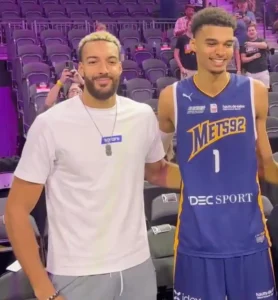
The photograph above puts him next to Rudy Gobert, who is listed at 7 feet 1 inch, or 2.16 m. Gobert is a four-time Defensive Player of the Year and one of the tallest men in the league. The gap is still visible.
Where 2.24 m sits against Britain’s tallest sportsmen
Height in basketball is hard to feel from the outside, because every player on the court is tall. Setting it against sports a British audience watches closely is more useful.
| Height | Name | Sport | Note |
|---|---|---|---|
| 2.31 m | Neil Fingleton | Basketball | Tallest living Briton 2007 to 2017; raised in County Durham |
| 2.24 m | Victor Wembanyama | Basketball | Tallest player in the NBA, listed |
| 2.13 m | Richard Metcalfe | Rugby union | Tallest man ever to play international rugby; Scotland |
| 2.08 m | Martin Bayfield | Rugby union | England lock and British and Irish Lions tourist |
| 2.06 m | Luol Deng | Basketball | Two-time NBA All-Star; Great Britain at London 2012 |
The name at the top of that table deserves more than a line. Neil Fingleton, raised in County Durham, was recognised by Guinness World Records in 2007 as Britain’s tallest man at 7 feet 7 inches, around 2.31 m. He was a basketball player first: he moved to the United States at sixteen, won a scholarship to the University of North Carolina, and then played professionally in Spain, China, Italy, Greece and England. He never reached the NBA. He later acted, as Mag the Mighty in Game of Thrones and the Fisher King in Doctor Who, and died of heart failure in February 2017, aged 36.
His career is the useful counterweight to everything written about Wembanyama. Fingleton was seven centimetres taller and had a serviceable professional career on three continents without ever being a top-level player. Height on its own does not produce what Wembanyama has produced. We have written about this gap before in our piece on the best sports for tall people.
Richard Metcalfe, the Scotland lock, holds the Guinness record as the tallest man ever to play international rugby union, at 2.13 m. He played for Newcastle Falcons, Northampton Saints, Edinburgh and the Borders. The sources disagree on his caps: Guinness says he represented Scotland in nine matches, Wikipedia records 13 caps between 2000 and 2001. Martin Bayfield, the England lock at 2.08 m, toured New Zealand with the Lions in 1993, and British readers are as likely to know him as Robbie Coltrane’s body double, playing Hagrid in the Harry Potter films. He published a memoir, A Very Tall Story, in 2022.
What shoe size does he wear?
He is reported at a UK 19.5, which is a US 20.5 on Nike’s own men’s conversion, or roughly a European 55. For scale, Nike’s British men’s chart runs out at UK 21.
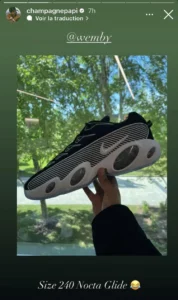
Three NBA players are commonly reported at larger: Shaquille O’Neal, Bob Lanier and Tacko Fall, all usually given as a US 22, or UK 21. These figures circulate widely but the NBA does not publish shoe sizes officially, so they are reported rather than certified. We have gone through the subject in more detail in our articles on the shoe sizes of NBA players and who has the largest feet in the world.
The practical point for anyone reading this with feet at the end of the British size range: Wembanyama’s shoes are made for him by a sponsor. For everyone else, a UK 15 is already where the high street stops, which is a problem of supply rather than of anatomy.
How he got there
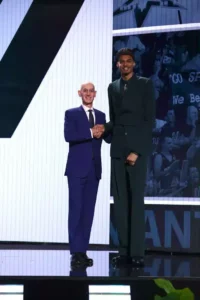
Born on 4 January 2004, he joined Nanterre 92 at the age of ten and was already around 1.80 m at eleven. He stayed at Nanterre until 2021, moved to ASVEL, the club chaired by Tony Parker, and then to Metropolitans 92 for the 2022-23 season. That final year in France made him a global story: he dominated the French league, took its MVP award, and removed any doubt about the first pick.
The San Antonio Spurs selected him first overall on 22 June 2023. With the French national team he had already been runner-up at the 2021 FIBA Under-19 World Cup, where he made the all-tournament five.
Four seasons, measured
The record, season by season, as a table rather than as a narrative.
| Season | Games | Points | Rebounds | Assists | Blocks |
|---|---|---|---|---|---|
| 2023-24 | 71 | 21.4 | 10.6 | 3.9 | 3.6 |
| 2024-25 | 46 | 24.3 | 11.0 | 3.7 | 3.8 |
| 2025-26 | 64 | 25.0 | 11.5 | 3.1 | 3.1 |
| 2026-27, to 2 November | 7 | 25.7 | 10.7 | 3.3 | 4.0 |
He has led the league in blocks in each of his first three seasons. The first of those seasons brought a unanimous Rookie of the Year award, all 99 first-place votes, a place on the All-Rookie First Team and, unusually for a first-year player, the All-Defensive First Team. He also finished second in the Defensive Player of the Year vote behind Rudy Gobert.
The second season was cut short. On 20 February 2025 the Spurs announced a deep vein thrombosis in his right shoulder and shut him down for the rest of the campaign. He had been among the favourites for Defensive Player of the Year at the time. He had surgery in March and returned to play in the summer.
What 2026 changed
The 2025-26 season is the one that moved him from phenomenon to established top player, and most articles written about him still predate it.
He averaged 25.0 points, 11.5 rebounds, 3.1 assists and 3.1 blocks across 64 games, started the All-Star Game for the Western Conference, and won Defensive Player of the Year as the youngest winner in the award’s history and its first unanimous selection. He was named to the All-NBA First Team and led the league in blocks for a third straight year.
He then took the Spurs to the NBA Finals and was named most valuable player of the Western Conference finals, averaging 23.8 points, 10.9 rebounds, 2.7 assists and 3.5 blocks across 22 playoff games, despite missing a game with concussion. San Antonio lost the Finals to the New York Knicks in five games, the Knicks’ first title since 1973.
Through the first seven games of 2026-27 he is averaging 25.7 points, 10.7 rebounds, 3.3 assists and 4.0 blocks, with a 43-point game against Minnesota on 31 October.
Why the profile is unusual
The reason to pay attention is not the height. It is what sits on top of it.
A player of 2.24 m is normally confined to a small area near the basket, because reach is his advantage and movement is his limit. Wembanyama handles the ball, shoots from distance, creates off the dribble, covers ground in transition, and protects the basket at an elite level at the same time. In his first season he became the first rookie to record at least 200 blocks and 100 three-pointers in a year, with 254 blocks, and completed a five-by-five, at least five points, rebounds, assists, steals and blocks in a single game. Those two lines do not usually belong to the same player, let alone the tallest one.
The caveat is the one his own medical history supplies. He has missed significant time in three of four seasons: a psoas injury in France in 2022, the shoulder thrombosis in 2025, a concussion in the 2026 playoffs. Whether a frame of this size holds up across a full career is the open question, and nothing in the record so far answers it.
The NBA seen from Britain
British readers have a better view of him than they used to, and the change is recent.
The NBA returned to London on 18 January 2026 for the first time in seven years, with the Orlando Magic playing the Memphis Grizzlies in front of 18,424 spectators. It drew the largest British television audience for any NBA Global Game, up 90 per cent on the last London game in 2019. Across a comparable run of fixtures, NBA viewing on Prime Video in the United Kingdom rose 312 per cent year on year. London, Berlin and Paris are all scheduled to host games across 2026, 2027 and 2028.
Britain’s own contribution to the sport at this height is thinner. Luol Deng, 2.06 m, naturalised British in 2006, was a two-time NBA All-Star with the Chicago Bulls and led Great Britain at the London Olympics in 2012, averaging 15.8 points, 6.6 rebounds and 4.6 assists in a campaign that ended one win and four defeats. He remains the high point. Beyond him, the British game has produced solid professionals rather than players of Wembanyama’s order.
Does the rugby comparison actually hold?
It is tempting to say that Metcalfe at 2.13 m and Bayfield at 2.08 m were doing something harder, in a contact sport, and in one respect that is true. A lock takes repeated collisions and lifts in the air at the lineout, which asks for mass and bracing strength that basketball does not.
But the demands pull in opposite directions. A rugby lock wants a long reach and a frame that can absorb impact; he does not need to change direction at speed or repeatedly jump from a standing start on a hard floor. Wembanyama’s sport asks for both, on a surface with no give, roughly 80 times a season. The two kinds of tall athlete are not really on the same scale, and ranking them by centimetres, as the table above does, is a way of giving a sense of scale rather than a comparison of difficulty.
What the British names do establish is that 2.24 m is genuinely rare even among people selected for sport specifically because they are tall. Metcalfe holds a world record at 11 centimetres shorter.
Further reading on Wetall
If this is the end of the scale that interests you, we have covered the tallest basketball players in the world, Sultan Kösen, the tallest living man, and Olivier Rioux, the tallest teenager in the world, who is a basketball player and taller than Wembanyama.
Sources
- Victor Wembanyama: listed height, season statistics, awards and injury history
- ESPN: Wembanyama 2026-27 game log and per-game averages
- NBA.com player page
- 2026 NBA Finals: New York Knicks beat San Antonio Spurs in five games
- Nike United Kingdom men’s footwear size chart
- Guinness World Records: tallest international rugby union player
- Richard Metcalfe: height, position and Scotland caps
- Martin Bayfield: height, England and Lions record, and later career
- Luol Deng: height, NBA career and Great Britain at London 2012
- International Business Times UK: Neil Fingleton, Britain’s tallest man
- Hoopsfix: NBA London Game 2026 attendance and British viewing figures
- NBA: three-year slate of games in Europe from 2026