Being tall is not an advantage in sport. Being tall is an advantage in some sports, a handicap in others, and completely irrelevant in most. The difference is mechanical, and once you understand the mechanics you can work out for yourself where your height will help you and where it will cost you.
This article takes that approach rather than handing you a league table. It explains the four physical reasons height matters, sets out what the Olympics actually measured, looks at the one occasion British sport went out and recruited tall people on purpose, and only then gives you the comparative table, built around the sports played in this country: rugby union and rugby league, cricket, netball, rowing, football.
The four reasons height changes a sport
Almost every advantage and every disadvantage of a tall body in sport comes back to one of four things.
Reach. A long arm puts your hand further from your shoulder. That is worth something whenever the contest is about touching a point in space before your opponent does: a lineout ball, a rebound, a block at the net, a jab, a save. Reach is the single most transferable advantage a tall athlete has.
Release height. Height above the ground changes the angle at which you send something away. A fast bowler releasing the ball 20 cm higher gets a steeper bounce off the same length. A volleyball player hitting above the net needs less spin to keep the ball in. A basketball player shooting over a defender does not need to jump as high.
Lever length. Long limbs move through more distance per cycle. In rowing that is more boat travel per stroke. In swimming it is a longer pull. But a long lever is also harder to accelerate and harder to stabilise, which is why the same long femur that helps you row makes a squat or a snatch mechanically worse.
Mass carried. A tall body is a heavy body. In any sport where you support your own weight against gravity, height is a tax. A runner absorbs roughly three times body weight at every footfall. A gymnast has to rotate the whole thing. A ski jumper has to be light. On water the tax disappears, which is why rowing and swimming suit tall people so well and distance running does not.
What the Olympics measured
Opinion on this subject is cheap, so it is worth starting with figures. Analysis of the athletes at the London 2012 Games produced the following average heights by sport, which is about as close to a fair comparison as you will get, since every athlete there was measured under the same accreditation process.
| Sport, London 2012 | Average height |
|---|---|
| Basketball | 192.1 cm (6 ft 3.5 in) |
| Volleyball | 189.7 cm (6 ft 2.5 in) |
| Beach volleyball | 187.0 cm (6 ft 1.5 in) |
| Rowing | 185.6 cm (6 ft 1 in) |
| Water polo | 185.6 cm (6 ft 1 in) |
| Handball | 183.8 cm (6 ft 0.5 in) |
| Swimming | 179.5 cm (5 ft 10.5 in) |
Two things stand out. The first is that swimming, which everybody assumes is a tall person’s sport, has a lower average than rowing or water polo, because the distance events pull it down. The second is that none of these averages is extreme. An Olympic basketball squad averages 1.92 m, not 2.10 m. If you are 1.95 m you are already above the mean in every sport on that list.
Sporting Giants: when British sport went looking for tall people
In February 2007, UK Sport launched a talent programme called Sporting Giants. Sir Steve Redgrave fronted it. The criteria were unusually blunt: aged 16 to 25, some athletic background, and a minimum height of 6 ft 3 in (190 cm) for men or 5 ft 11 in (180 cm) for women. Three sports were targeted, all chosen because height was believed to pay in them: rowing, handball and volleyball.
4,800 people applied and 3,854 met the criteria. Ten of them were in the Team GB squad at the 2012 Games, including the four men and two women who made up Britain’s first ever Olympic handball teams. Both handball sides lost every group match, which is a reasonable measure of how far a programme can get you from a standing start in five years.
The rowing results were different. Victoria Thornley came fifth in the women’s eight. Helen Glover, recruited in 2008 with no rowing experience at all, won gold in the coxless pairs in 2012 and again in 2016. The detail worth keeping is that Glover was 178 cm, below the programme’s own minimum for women, and was reportedly measured on tiptoes to get in. The height criterion was a filter for finding people, not a law of physics.
That is the honest summary of this whole subject. Height moves the odds. It does not decide anything.
Comparative table: sport by sport
The table below rates each sport for a tall adult, with the reason attached. A sport marked neutral is not a bad sport. It simply means your height will neither help nor hurt you, so choose it on whether you enjoy it. Where the verdict depends on position, the comment says which position.
| Sport | Verdict for a tall body | Why |
|---|---|---|
| Athletics | ||
| High jump | Very well suited | The centre of mass starts higher. Being slender matters more than being tall, but tall and slender is the winning build. |
| Long jump | Suited | Long levers help, provided you stay light enough to run fast on the approach. |
| Shot, discus, javelin | Suited | A longer throwing arc and a higher release point. |
| 3000 m steeplechase | Suited | The barriers are fixed at 91.4 cm, so a long leg clears them with less disruption to the stride. |
| Sprinting | Neutral | Long legs cover ground but start slowly. Usain Bolt at 1.95 m is the exception that proves the rule, not the rule. |
| Middle and long distance | Neutral to poorly suited | Running economy falls as mass rises. Past roughly 2 m, endurance events get harder. |
| Team sport | ||
| Rugby union | Very well suited | The second row exists for tall people. The lineout is a contest for a ball in the air. |
| Rugby league | Suited | No lineout, so no dedicated tall position, but reach and mass help in the middle. |
| Netball | Very well suited | Goal keeper and goal shooter are height positions. Defending the shot is pure reach. |
| Basketball | Very well suited | The clearest case in sport. Release height and rebounding both scale with height. |
| Volleyball | Very well suited | Blocking and spiking happen above a fixed net. |
| Beach volleyball | Very well suited | Same net, two players, so there is nowhere to hide and nowhere you are not useful. |
| Water polo | Very well suited | Reach for passing, shooting and goalkeeping, with no weight penalty in water. |
| Handball | Suited to very well suited | Strongly suited at pivot and in goal. One of the three Sporting Giants sports. |
| Cricket | Suited | Fast bowling rewards a high release point. Little advantage in batting. |
| Football | Neutral | Useful at centre back, in goal and at set pieces. A disadvantage almost everywhere else. |
| Field hockey | Neutral | A low stick position suits shorter players. Reach helps in goal. |
| Ice hockey | Neutral | Little advantage outfield, some in goal. |
| American football | Suited | An advantage at specific positions on the line and at receiver. |
| Baseball | Neutral | Tall pitchers exist, but height has never been shown to be a reliable edge. |
| Racket sport | ||
| Tennis | Suited | A high serve contact point is worth a great deal. Movement and low balls are the cost. |
| Badminton | Suited | Longer limbs cover more of the court from a central position. |
| Table tennis | Suited | Reach helps at modern distances from the table. |
| Squash | Poorly suited | A small court and constant changes of direction punish a heavy body. |
| Water sport | ||
| Rowing | Very well suited | More distance per stroke, and the boat carries your weight rather than your joints. |
| Swimming | Very well suited | A longer pull, good buoyancy with a large trunk, no weight penalty. Sprint events above all. |
| Canoeing and kayaking | Neutral | Reach helps, a high centre of gravity in a narrow boat does not. |
| Sailing, windsurfing | Neutral | Depends entirely on the class and the crew role. |
| Surfing | Poorly suited | A higher centre of gravity on an unstable platform. |
| Combat sport and martial arts | ||
| Boxing | Very well suited | Reach decides distance, and distance decides who gets hit. |
| Kickboxing | Very well suited | Both the arms and the legs become weapons at range. |
| Taekwondo | Very well suited | Scoring is largely about landing a long leg first. |
| Karate | Very well suited | Extension gives a clear advantage in the scoring exchange. |
| Judo | Very well suited | Strongly suited in the heavy categories, where grip and leverage reward length. |
| Jujitsu and Brazilian jiu-jitsu | Suited | Long limbs open more submissions, and more routes to be submitted. |
| Kendo | Suited | Reach again, this time with a weapon. |
| Fencing | Suited | A longer lunge and a longer arm both shorten the distance you must cover. |
| Wrestling | Suited | Length plus mass is a workable combination, though low positions are harder. |
| Aikido | Poorly suited | The techniques assume you can get low and stay close. Years of practice do not change the geometry. |
| Capoeira | Poorly suited | Very low circular movement is the worst case for long levers. |
| Cycling | ||
| Road cycling | Neutral | Neither advantage nor handicap, as long as the frame actually fits you. |
| Mountain biking | Neutral | As above, with more attention needed to standover height. |
| Track sprint | Poorly suited | The winning build is short, dense and powerful. |
| Strength sport | ||
| Strongman | Suited | Loading, carrying and overhead events reward length and total mass. |
| Powerlifting | Suited | Long arms help the deadlift. Long legs hurt the squat. It roughly balances. |
| Bodybuilding | Suited | More frame to fill, which takes longer but finishes larger. |
| Olympic weightlifting | Poorly suited | The bar has further to travel and the positions are mechanically worse. |
| Outdoor and winter sport | ||
| Climbing | Suited | Reach between holds is real, provided you are not carrying much weight. |
| Cross-country skiing | Suited | Long levers, and the skis spread the load. |
| Hiking and mountaineering | Neutral | Long stride on, more load on the knees downhill. It cancels out. |
| Fell and hill running | Neutral to poorly suited | Climbing is fine. Steep descents punish a high centre of gravity. |
| Alpine skiing | Neutral | Height is not a factor at amateur level, and a mixed one at the top. |
| Snowboarding | Neutral | Board length scales with you. |
| Speed skating | Neutral | Few champions are tall, but nothing in the event forbids it. |
| Ski jumping | Not suited | The event has been engineered around light, small athletes. |
| Bobsleigh | Not suited | You have to fold into a small sled, fast. |
| Figure skating | Not suited | Rotation speed falls as limb length rises. |
| Gymnastics | Not suited as an adult | Excellent for a growing child’s strength and mobility. Very hard to continue once the mass arrives. |
| Target sport | ||
| Golf | Neutral | A wider arc, more to coordinate, and clubs that need fitting. |
| Archery | Neutral | A longer draw length needs a longer bow, nothing more. |
| Darts and bowls | Neutral | No mechanical effect. Worth saying, because the question gets asked. |
Rugby union: the one position built for height
No other British sport has a role that exists specifically because somebody is tall. The second row does. The lineout is a jump for a thrown ball, and winning it is a function of standing reach plus lift.
The tallest man to play international rugby union is the Scotland lock Richard Metcalfe at 2.13 m (7 ft). England’s tallest capped forward is Martin Bayfield at 2.08 m (6 ft 10 in), who won 31 England caps and three for the British and Irish Lions in 1993. Ireland’s Devin Toner is also 2.08 m, Wales had Luke Charteris at 2.06 m, and Scotland’s Richie Gray and England’s Joe Launchbury come in at 2.03 m and 2.01 m. That is a list of international careers built in large part on height, which is not something you can say about most sports.
Rugby league is a different proposition. There is no lineout, so there is no position whose job description is height. Tall forwards do well in the middle, where reach in the tackle and mass in contact both count, but the game asks for more repeated running than union does, and that is where a heavy frame starts costing you.
Cricket: the bowler’s angle
Cricket is the British sport where height produces the most under-appreciated advantage. A bowler who releases the ball higher gets a steeper trajectory into the pitch and more bounce off the same length, which is uncomfortable in a way that pace alone is not.
The tallest man to bowl in international cricket is Pakistan’s Mohammad Irfan at 2.16 m (7 ft 1 in). From these islands, Boyd Rankin, who played for both Ireland and England, is 2.04 m (6 ft 8.5 in). Steven Finn and Chris Tremlett are both 2.01 m (6 ft 7 in), David Larter was 2.00 m and Tony Greig 1.98 m. Batting is another matter: a tall batter has a longer reach forward but a higher point of contact to control, and there is no evidence height helps.
Netball: height written into the positions
Netball deserves more attention from tall readers than it gets, and it is one of the few sports in Britain where that is as true for women as for men elsewhere. Goal keeper and goal shooter are height roles. Defending a shot in netball is almost entirely a question of getting a hand nearer to the ball than the shooter can get the ball above your hand, with a fixed three-foot marking distance that makes reach decisive.
Geva Mentor, at 1.91 m (6 ft 3 in), played goal keeper for England 175 times between 2001 and 2023, won Commonwealth gold in 2018 and a World Cup silver in 2023, and was appointed CBE in 2019. Twenty-four years at the top of a sport is the sort of career that tends to follow when the body and the position match.
Rowing: the strongest case of all
If you are tall, under 25 and want the shortest route from nothing to a serious competitive level, rowing is the answer, and Sporting Giants is the evidence. Two things combine. A longer body puts more distance into every stroke, so the same effort moves the boat further. And the boat, not your knees, carries your weight, which removes the single biggest penalty of being tall in endurance sport.
The Olympic average of 185.6 cm understates it, because that figure pools lightweight and open categories. In the open men’s eight the crews run considerably taller. British Rowing still tests tall beginners with no rowing background, and still names Helen Glover when it does.
Swimming and water polo
Water removes the weight tax, which is why both of these sports suit tall bodies. In swimming the advantage is the pull: a longer arm moves more water per stroke, and a large trunk floats better, which is a sprinter’s combination. The 1990s turned this into a template, and the Australian Ian Thorpe became the symbol of it. His feet were widely reported as a size 17, which in Australian and American sizing works out at around a UK 16. Treat that as a conversion rather than a measurement, because no source gives his British size.
Water polo is less visible in Britain and more demanding than almost anything else on this list. Reach governs passing, shooting and above all goalkeeping, where the goal is a fixed size and your span is not.
High jump
The high jump is the purest case: the object is to raise your centre of mass over a bar, and a tall athlete’s centre of mass starts higher. The world record of 2.45 m has stood to Cuba’s Javier Sotomayor since 1993 and has not been approached since. The British record is 2.38 m indoors, set by Steve Smith at Wuppertal in February 1994, with 2.37 m outdoors.
Smith himself was 1.85 m, which is worth noting. The event rewards height, but it rewards a jumper’s power-to-weight ratio more, and that is why the elite field clusters around 1.90 m rather than 2.05 m.
Combat sport: reach, and British heavyweights
Reach is the cleanest advantage in all of sport, because distance control decides who lands and who does not. British heavyweight boxing has spent thirty years demonstrating it. Tyson Fury stands 2.06 m (6 ft 9 in), Anthony Joshua 1.98 m (6 ft 6 in) and Lennox Lewis 1.96 m (6 ft 5 in). Add Russia’s Nikolay Valuev at 2.13 m, the Klitschko brothers at 1.98 m and 2.01 m, and the American Deontay Wilder at 2.01 m, and the heavyweight division of the last three decades reads as an argument for height.
Away from boxing, the Dutch kickboxer and karateka Semmy Schilt at 2.12 m and France’s judo heavyweight Teddy Riner at 2.04 m (6 ft 8 in) make the same point in striking and in grappling.
Football: a narrow but real niche
Football is the sport tall British readers ask about most and the one where the answer is least satisfying. Height is useful at centre back, essential in goal, and valuable at both ends of a set piece. Everywhere else it is a mild liability, because the game rewards changes of direction and a low centre of gravity.
So the honest verdict is neutral. There have been very tall professionals, and there will be more, but no outfield position in football exists because somebody is tall, in the way that the second row in rugby or goal keeper in netball does.
Where height is simply a problem
It is as useful to know what to avoid. Ski jumping, bobsleigh and figure skating are closed doors for a tall adult: the first has been engineered around light bodies, the second requires you to fold into a small sled quickly, the third depends on rotational speed that falls as your limbs lengthen. Track sprint cycling selects for short and dense. Squash punishes a heavy body on a small court. Olympic weightlifting asks the bar to travel further through worse positions. Gymnastics is excellent for a growing child and close to impossible to continue once the adult mass arrives.
None of that is a verdict on you. It is a verdict on the match between a body and a rulebook.
How to actually choose
Three pieces of advice, in order of importance.
- Pick the sport you want to turn up to in February. Enthusiasm beats mechanics over any timescale that matters.
- If you genuinely have no preference, start with rowing, netball, volleyball or rugby union, in that order, because each has either a dedicated structure for tall beginners or a position that needs you.
- If you are starting as an adult and carrying weight, start in the water or on a bike, not on the road. The three-times-body-weight footfall is the thing that ends new running habits.
And if your height is making the equipment the problem rather than the sport, that is a different and more solvable question. A bike that does not fit is a frame problem, not a cycling problem, long levers change how you should approach the squat, and a coach’s view on running when you are tall is worth more than any table.
Further reading on Wetall
- The tallest basketball players in the world, for the sport where height pays most.
- The tallest footballers of all time, for the narrow niche described above.
- Tyson Fury, for what reach looks like in practice.
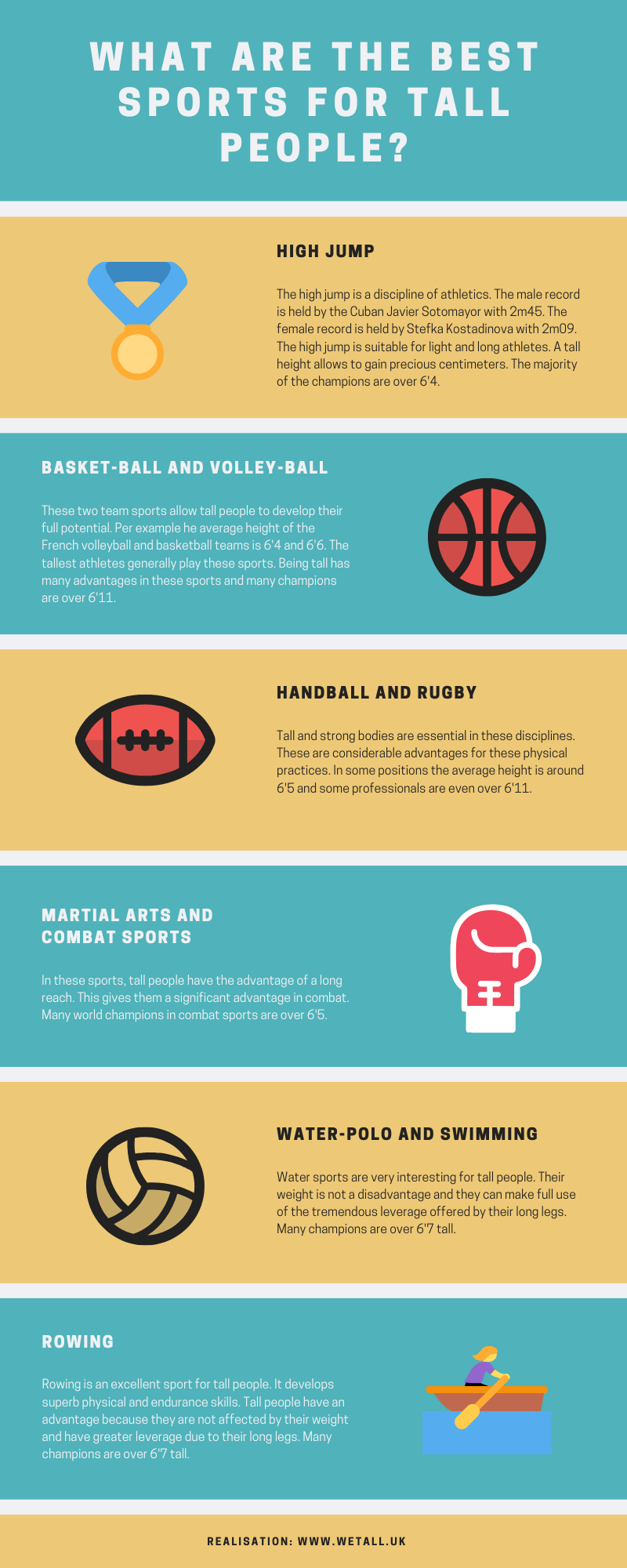
Below is our summary infographic of the best sports for tall people.
Sources
- Topend Sports, average height of athletes by sport at the London 2012 Olympic Games: topendsports.com
- UK Sport, Sporting Giants talent programme, launched February 2007, criteria and outcomes: uksport.gov.uk
- British Rowing, current tall-athlete talent testing and the Helen Glover intake: britishrowing.org
- Ruck, tallest rugby union internationals with heights: ruck.co.uk
- Topend Sports, tallest cricketers with measured heights: topendsports.com
- England Netball and Netball Super League records for Geva Mentor’s caps and honours: netballsl.com
- World Athletics, high jump world record and British records: worldathletics.org