Today, Wetall proposes to discover everything you need to know about running when you’re tall! To do this, nothing better than an expert in the field: Guillaume Adam.
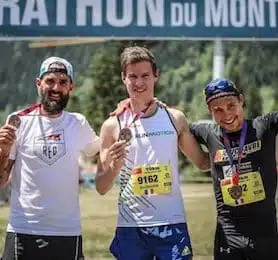
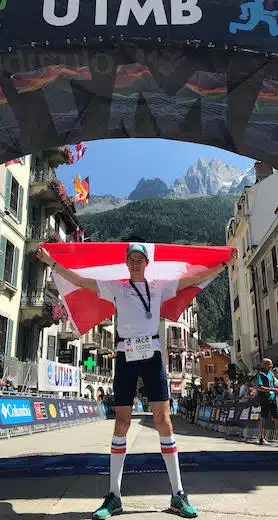
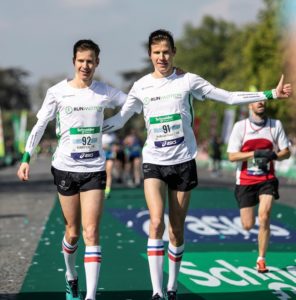
Guillaume is a high-level runner. He runs the marathon in 2h23, won the Maxi Race in Annecy (110 km trail) and has 10 French championship titles. He also created, with his brother, a running coaching application called RunMotion. And as if that wasn’t enough, he has just released a book on running called “”My bible of running, trail and marathon””.
1. Can you introduce yourself in a few words?
I’m 33 years old and I live in Chambéry in the Alps. I’ve been running since I was 10 years old and at 23 I joined the French athletics team on 1500 metres. In 2017, I founded RunMotion Coach, a running coaching application, with the aim of helping all runners, regardless of their level, achieve their goals. These goals can be related to weight loss or races such as the Paris Marathon, where over 2000 runners prepared with our application in 2023. Now I run mainly for pleasure, whether on marathon or trail.
And why an interview on Wetall? I’m 1m88 tall and especially I wear size 48 shoes. Sometimes I have difficulty finding certain shoes, but online, in 95% of cases, it works!
2. What are your best running memories?
One of my best memories is when I managed to break the 4-minute mile (1609m). This is a feat that was thought to be impossible at the beginning of the 20th century, but a Briton proved otherwise in 1954. It was in Boston in 2017 that I ran the mile in 3 minutes and 59 seconds for the first time, in a race where I was with the Olympic champion from Rio on 1500m, American Matthew Centrowitz!
3. Is running recommended for tall people?
Yes, running is recommended for just about everyone. Humans are designed to run (you just have to watch children running around a playground), but years of sedentary living can have left the body unaccustomed to this effort. You then need to go gradually, alternating walking and running.
4. What training adaptations should you make when you’re tall and just starting running?
Tall runners are sometimes a bit heavy, and in this case you need to be even more progressive in your practice. It may be preferable to favour trails rather than roads to reduce muscular and joint strain, whilst being careful of branches in the woods.
Running technique is important in running to have an economical and fluid motion, and it is also advisable to do exercises to work on your cadence, because in general, tall runners have a wide stride but low cadence.
5. What are the particularities of tall people in running?
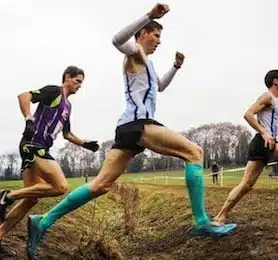
Tall people have a higher centre of gravity, which is a disadvantage, particularly in trail when descending. It is therefore important to anticipate and use your arms to bring your centre of gravity closer to the slope, for example in bends. Furthermore, with each footfall, a runner supports approximately 3 times their weight. The heavier a runner, the greater the muscular and joint strain. Shoes with sufficient cushioning are therefore recommended. Shoes like Asics Nimbus are often favoured by heavy runners, but if you’re looking for more dynamism and have the technique, you can opt for slightly lighter shoes.
6. Does a tall person need to eat more than others when training or competing?
A person with more lean mass (muscles) has a higher basal metabolism. This is the amount of energy needed each day if you remain inactive. With activity, it’s not uncommon for a tall person to need 2,500 to 3,000 kilocalories per day. It’s important to consume good quality fats, particularly omega-3 and omega-6, which also provide kilocalories to the body, whereas vegetables are often low in kilocalories but rich in vitamins and minerals. It is therefore recommended to have a healthy diet in general, like anyone else really.
In competition, approximately 40 to 50g of carbohydrate per hour is recommended for a marathon or effort lasting between 1 and 5 hours. For tall people, this amount can go up to 60g. Beyond that, the body may not assimilate them. It’s important to test what you consume during training to know what works in competition. For trail, healthy foods like Baouw bars and purees are interesting, as industrial products such as gels can cause intestinal discomfort. Some runners tolerate them well, so it’s necessary to test in advance, both nutritionally and equipment-wise.
7. Does a tall runner need special equipment?
With regard to hydration, it’s recommended to drink between 40 cl and 70 cl of water per hour of running. Therefore, a tall runner can aim for the upper end of this range. After the race, it’s better to choose a pint of beer rather than a half, but I’m joking! By the way, I have an English mate who is 2m01 tall, who is a British wife-carrying champion (yes, that’s a thing!) and that’s an advantage of being tall, and especially the winner gets his weight in beer, so double advantage of being tall.
With regard to trail, walking poles can be a bit more fragile, because a long pole tends to break more easily. In this case, aluminium poles, although slightly heavier than carbon ones, can be more durable.
8. Which running disciplines are most advantageous for tall people?
On the 3000m steeplechase, we had two Frenchmen used to podium finishes at world and Olympic level, Bob Tahri (1m91) and Mahiedine Mekhissi (1m90), which seems to indicate an advantage with the 91cm barriers. In trail, François d’Haène, measuring 1m92, is also a champion ultra-trail runner! However, in these two disciplines there are also short athletes who excel. With regard to sprint events such as the 100m and 200m, Usain Bolt, at 1m95, also made history in this discipline usually favoured by shorter and faster runners. Beyond 2 metres, endurance disciplines are often more difficult, as running economy is less efficient.
9. You launched a running coaching application with your twin brother, can you introduce it to us?
RunMotion Coach has been downloaded over 500,000 times and supports runners of all levels. We are delighted to read testimonials from people whose lives have been transformed by achieving their running goals, whether on a physical or mental level, by developing better self-confidence, for example. Knowing that RunMotion Coach helped them in this transformation is a great success for us.
Bonus. What do you think of Wetall?
I was delighted to discover this community where, at first, with my small height of 1m88, I didn’t think I fitted in, but my shoe size 48 allowed me to join this club! I appreciate the blog articles that let you discover incredible stories and get practical advice! Furthermore, featuring articles suited to tall people makes it easier to search for products that match our needs.
Thank you Guillaume for these valuable tips! You can follow him on Facebook and Instagram. And for runners, don’t forget to download the RunMotion application to maximise your chances of sporting success!