Wetall offers you today an exceptional interview with Julien Rebeyrol, dietitian-nutritionist for major team sports clubs. We won’t say more, the rest is in the interview below!
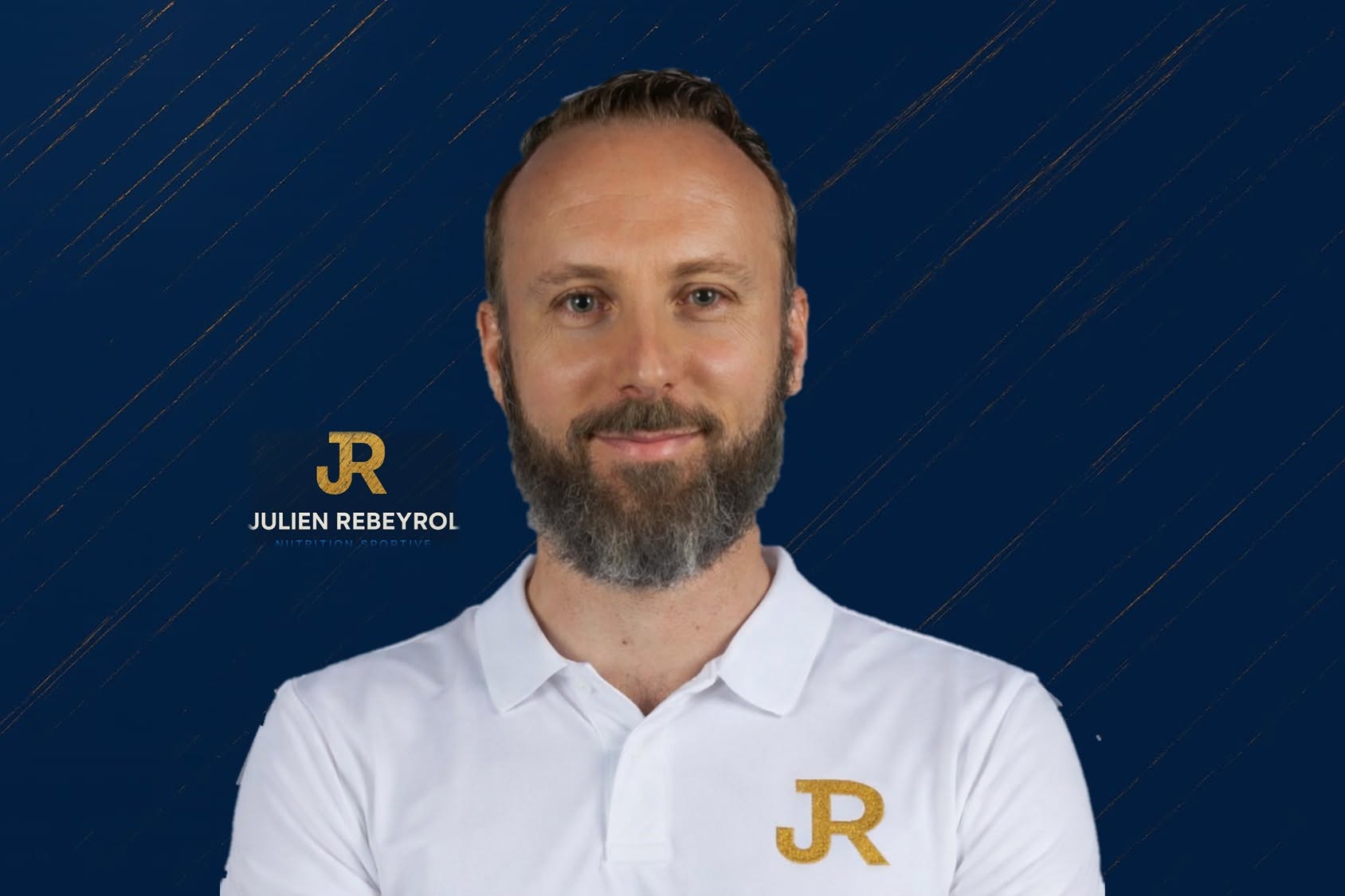
1/ Can you introduce yourself in a few words?
Hello, I’m Julien Rebeyrol, a dietitian-nutritionist for over 10 years, specialising in sports nutrition. I’m based in Lyon in charge of nutritional support for LOU Rugby for 7 seasons. I also provide follow-ups with the men’s and women’s basketball teams at ASVEL where I had the opportunity to follow in particular Victor Wembanyama, Nando de Colo and Héléna Ciak. I also consult at the Paul SANTY paramedical centre in Lyon (1)
I hold a DUT in biological engineering with a dietetics option as well as a Postgraduate Diploma in sports nutrition. Previously I had obtained a STAPS degree in coaching and a master’s in physical preparation.
I also teach at university where I give sports nutrition lectures and give talks in clubs or with the SFNS-French society for sports nutrition. (2)
2/ What is the difference between a dietitian and a nutritionist?
Either you are a dietitian-nutritionist or you are a doctor nutritionist. Outside of these two designations, people practise without a diploma.
A simple “”nutritionist”” or “”nutrition officer”” has no diploma to practise. You must therefore be extremely cautious.
The internet and especially social media are full of incredible nonsense when it comes to nutrition. It is vital for your health not to believe everything you read. Those who wish real nutritional advice should see a dietitian, everything else is not scientific.
3/ Do you often come across tall people or large builds in your work?
Absolutely. Because of my work at the LOU Rugby professional club, I see very strong builds, some even exceed 2m like Romain Taofifenua at 2m03 for 135kg. The same with Victor Wembanyama who is over 2m22.
Despite my 1m80 I seem small at ASVEL or at LOU!
4/ What are the specific features of tall people in terms of nutrition?
In reality, there aren’t any. Height does not impact the athlete’s nutrition. It is the weight due to this height that will impact it.
At equal expenditure, whether the athlete is 2m10 or 1m95, if in both cases they weigh 105kg the differences in energy requirements will not be so different: in short, weight impacts needs more than height.
We can still see specific features on extremely tall cases like with Victor when he played at ASVEL
5/ What should a tall athlete be careful about?
Nothing more than a person of different height. You need to pay attention to your needs in lipids, proteins and carbohydrates rather than your calories. You also need to be supported by a dietitian if you have serious goals.
6/ What dietary advice can you give to tall people?
Nothing more than those of different height. As mentioned above, it is mainly the person’s weight that will determine what they eat.
7/ What dietary advice could you give to tall people who want to lose weight?
I repeat but these are the same as for those of shorter height.
You need to stop eliminating fat and stop eliminating starchy foods in the evening. These are clichés. In the same way, fat is not bad, quite the opposite.
It is above all about listening to food sensations, that’s what’s most important. (3)
I also recommend real support and follow-up by a qualified dietitian.
Remember well that no food makes you gain or lose weight, it’s all a question of context, hunger sensation and achieving satiety.
8/ And for tall people who want to gain muscle mass?
The same as for other heights. You must first adjust macronutrient intake based on weight. Then you need to adjust your food intake according to your training sessions (training or competition). And finally you need to adjust the number of meals you have during the day. (4)
9/ What final advice can you give to tall people who need to watch their diet daily (app? use an impedance scale)?
Definitely not an app! It’s a vector of eating disorder because it produces a need based on a flawed algorithm which is the opposite of sensations. The same goes for scales, it’s pointless, we don’t measure felt temperature based on the clothes we have. You need to base yourself on intuition based on our sensations.
As part of a programme, go and see a dietitian. Most athletes using apps can drift towards eating disorder. (5, 6)
Some athletes were doing Instagram challenges and ended up in poor health situations. It was detrimental to their careers.
Regarding impedance scales it’s nonsense for several reasons. First, most models don’t have handles and therefore don’t allow logical circulation of the tension needed to analyse body composition. Then, these scales aren’t super reliable. And finally, because the results can be biased depending on the water present in the body. So completely pointless. It’s best to use medical devices with real validity, which is not the case with this type of scale.
10/ What do you think of Wetall?
It’s great because tall people often feel set apart and abandoned, their specific needs are not sufficiently taken into account and Wetall helps. Tall people now feel less isolated.
We tend to better understand a person in an obese situation whereas a thin-built person will experience the same suffering as them, for tall people it’s the same we don’t always see the negative aspects of being tall, and for that Wetall helps a lot.
See you soon!
References
- : https://cpsanty.fr/index.php/lequipe/dieteticien/
- : https://www.nutritiondusport.fr/
- : Karine GRAVEL & Tribole E. and Resch E. Intuitive Eating, 4th Edition: A Revolutionary Anti-Diet Approach. St. Martin’s Essentials, 2020
- American Dietetic Association; Dietitians of Canada; American College of Sports Medicine; Rodriguez NR, Di Marco NM, Langley S. American College of Sports Medicine position stand. Nutrition and athletic performance. Med Sci Sports Exerc. 2009 Mar;41(3):709-31. doi: 10.1249/MSS.0b013e31890eb86. PMID: 19225360.
- Mountjoy M, Sundgot-Borgen J, Burke L, Carter S, Constantini N, Lebrun C, Meyer N, Sherman R, Steffen K, Budgett R, Ljungqvist A, Ackerman K. RED-S CAT. Relative Energy Deficiency in Sport (RED-S) Clinical Assessment Tool (CAT). Br J Sports Med. 2015 Apr;49(7):421-3. doi: 10.1136/bjsports-2015-094873. PMID: 25896450.
- UEFA expert group statement on nutrition in elite football. Current evidence to inform practical recommendations and guide future research (Collins J, et al. Br J Sports Med 2020;0:1–27. doi:10.1136/bjsports-2019-101961
Thnk you to Julien for this constructive exchange! If you enjoyed this article, you should check out these too: