Most running advice assumes a body of average size. If you are 1.90 m and carrying the weight that usually comes with it, the standard beginner’s plan asks your knees to absorb a load it was never written for, and the standard shoe chart runs out before your size does. So we asked somebody who runs at a high level and who is tall enough to have had to solve the problem himself.
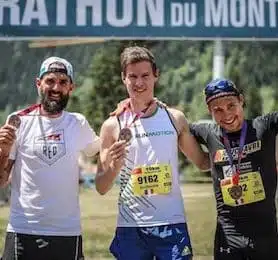
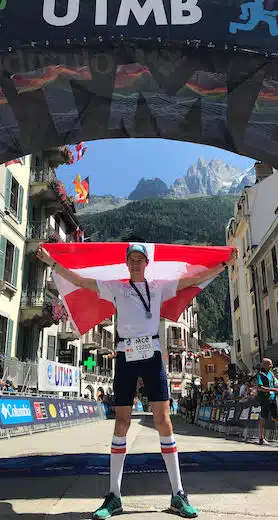
Guillaume Adam runs the marathon in 2 hours 23, won the Maxi Race in Annecy, a 110 km trail, and holds 10 French championship titles. He founded the running coaching app RunMotion with his brother, and he has written a book on running, trail and marathon. He is 1.88 m and wears a size 48, which is why he is talking to us. His answers below are his own words, reproduced unchanged. Everything outside the quoted answers is our own, including the British context we have added where it seemed useful.
Can you introduce yourself in a few words?
I’m 33 years old and I live in Chambéry in the Alps. I’ve been running since I was 10 years old and at 23 I joined the French athletics team on 1500 metres. In 2017, I founded RunMotion Coach, a running coaching application, with the aim of helping all runners, regardless of their level, achieve their goals. These goals can be related to weight loss or races such as the Paris Marathon, where over 2000 runners prepared with our application in 2023. Now I run mainly for pleasure, whether on marathon or trail.
And why an interview on Wetall? I’m 1m88 tall and especially I wear size 48 shoes. Sometimes I have difficulty finding certain shoes, but online, in 95% of cases, it works!
Wetall’s note. A continental 48 is roughly a UK 13. That is a conversion rather than a measurement, because manufacturers vary and running shoes in particular tend to run small. If you are above a UK 13 you will find road shoes available but your choice of trail shoes narrows sharply, and the cushioned models Guillaume recommends further down are usually the last to be stocked in the largest sizes.
What are your best running memories?
One of my best memories is when I managed to break the 4-minute mile (1609m). This is a feat that was thought to be impossible at the beginning of the 20th century, but a Briton proved otherwise in 1954. It was in Boston in 2017 that I ran the mile in 3 minutes and 59 seconds for the first time, in a race where I was with the Olympic champion from Rio on 1500m, American Matthew Centrowitz!
Wetall’s note. The Briton is Roger Bannister, who ran 3 minutes 59.4 seconds at the Iffley Road track in Oxford on 6 May 1954. He was a medical student at the time, and he was paced by Chris Brasher and Chris Chataway. The barrier had held for years and then fell twice in seven weeks: John Landy took the record in Turku on 21 June 1954, 46 days later. That is the usual pattern once something is shown to be possible.
Is running recommended for tall people?
Yes, running is recommended for just about everyone. Humans are designed to run (you just have to watch children running around a playground), but years of sedentary living can have left the body unaccustomed to this effort. You then need to go gradually, alternating walking and running.
Wetall’s note. If you are starting from nothing in Britain, the obvious first step is a Saturday parkrun. It is free, it is 5 km, it is timed, and nobody minds how long you take or whether you walk part of it. Walk and run intervals are the normal way in, and a 5 km event removes the question of how far to go, which is the question new runners get wrong most often.
What training adaptations should you make when you’re tall and just starting running?
Tall runners are sometimes a bit heavy, and in this case you need to be even more progressive in your practice. It may be preferable to favour trails rather than roads to reduce muscular and joint strain, whilst being careful of branches in the woods.
Running technique is important in running to have an economical and fluid motion, and it is also advisable to do exercises to work on your cadence, because in general, tall runners have a wide stride but low cadence.
Wetall’s note. The cadence point is the single most useful thing in this interview and the easiest to act on. A long leg naturally produces a long, slow stride, which means more time in the air, a harder landing and more braking on each footfall. Counting your steps for a minute on your next run will tell you where you are. Most runners sit somewhere in the 150s to 160s and most tall beginners sit lower. Raising it by a few steps per minute, without trying to run faster, shortens the stride and softens the landing.
The advice to favour trails over roads is worth taking more literally in Britain than it sounds, because almost nobody here lives far from a bridleway, a towpath or a park loop. The branch warning is not a joke either, and it is the one hazard tall runners have to manage that nobody else thinks about.
What are the particularities of tall people in running?
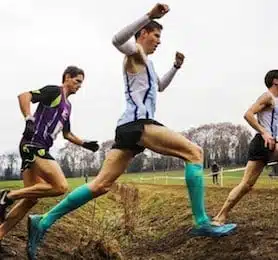
Tall people have a higher centre of gravity, which is a disadvantage, particularly in trail when descending. It is therefore important to anticipate and use your arms to bring your centre of gravity closer to the slope, for example in bends. Furthermore, with each footfall, a runner supports approximately 3 times their weight. The heavier a runner, the greater the muscular and joint strain. Shoes with sufficient cushioning are therefore recommended. Shoes like Asics Nimbus are often favoured by heavy runners, but if you’re looking for more dynamism and have the technique, you can opt for slightly lighter shoes.
Wetall’s note. Three times body weight on every footfall is the number to hold on to, because it scales with you. At 70 kg that is about 210 kg through the joint. At 95 kg it is about 285 kg, on the same stride, in the same shoe. That is why the progression advice matters more for tall beginners than for anybody else, and why the cushioning question is not vanity.
The descending problem has its own culture in this country. Fell running in the Lake District, the Peak District and the Welsh hills is almost entirely a descending skill, and it is where a high centre of gravity costs most. The technique Guillaume describes, using the arms to bring the mass towards the slope, is exactly what fell runners do on a steep line, and it is worth learning on a short, gentle descent before you need it on a long one.
Does a tall person need to eat more than others when training or competing?
A person with more lean mass (muscles) has a higher basal metabolism. This is the amount of energy needed each day if you remain inactive. With activity, it’s not uncommon for a tall person to need 2,500 to 3,000 kilocalories per day. It’s important to consume good quality fats, particularly omega-3 and omega-6, which also provide kilocalories to the body, whereas vegetables are often low in kilocalories but rich in vitamins and minerals. It is therefore recommended to have a healthy diet in general, like anyone else really.
In competition, approximately 40 to 50g of carbohydrate per hour is recommended for a marathon or effort lasting between 1 and 5 hours. For tall people, this amount can go up to 60g. Beyond that, the body may not assimilate them. It’s important to test what you consume during training to know what works in competition. For trail, healthy foods like Baouw bars and purees are interesting, as industrial products such as gels can cause intestinal discomfort. Some runners tolerate them well, so it’s necessary to test in advance, both nutritionally and equipment-wise.
Wetall’s note. The 60 g per hour ceiling is a useful planning figure. Most gels sold in Britain carry between 20 g and 25 g of carbohydrate, so that is two to three an hour, and a standard 500 ml sports drink adds roughly 30 g. Work that out before race day rather than at an aid station. The point about testing applies to the brand as much as the quantity, because tolerance is individual and a marathon is the wrong place to discover you do not have any.
Does a tall runner need special equipment?
With regard to hydration, it’s recommended to drink between 40 cl and 70 cl of water per hour of running. Therefore, a tall runner can aim for the upper end of this range. After the race, it’s better to choose a pint of beer rather than a half, but I’m joking! By the way, I have an English mate who is 2m01 tall, who is a British wife-carrying champion (yes, that’s a thing!) and that’s an advantage of being tall, and especially the winner gets his weight in beer, so double advantage of being tall.
With regard to trail, walking poles can be a bit more fragile, because a long pole tends to break more easily. In this case, aluminium poles, although slightly heavier than carbon ones, can be more durable.
Wetall’s note. In British measures, 40 to 70 cl per hour is roughly 0.7 to 1.2 pints, so a tall runner on a warm day is looking at about a pint an hour. That is more than a single 500 ml soft flask holds, which is the practical reason tall runners end up carrying two.
And since Guillaume raised it: the UK Wife Carrying Race is real, it is run at Dorking in Surrey, and the winner’s prize is a barrel of ale. The 2026 edition was the seventeenth and was won by a Finnish pair, which is fair enough given that the sport originated there.
On poles, the leverage argument is sound and under-reported. A longer pole takes a greater bending load for the same force at the handle, so a tall runner on technical ground breaks carbon poles that a shorter runner would not. Aluminium bends rather than snaps, which on a mountain is the failure mode you want.
Which running disciplines are most advantageous for tall people?
On the 3000m steeplechase, we had two Frenchmen used to podium finishes at world and Olympic level, Bob Tahri (1m91) and Mahiedine Mekhissi (1m90), which seems to indicate an advantage with the 91cm barriers. In trail, François d’Haène, measuring 1m92, is also a champion ultra-trail runner! However, in these two disciplines there are also short athletes who excel. With regard to sprint events such as the 100m and 200m, Usain Bolt, at 1m95, also made history in this discipline usually favoured by shorter and faster runners. Beyond 2 metres, endurance disciplines are often more difficult, as running economy is less efficient.
Wetall’s note. The steeplechase barrier is fixed at 91.4 cm, or three feet, for men, and 76.2 cm for women. That is the whole argument in one number: the obstacle does not scale with you, so a long leg clears it with less disruption to the stride and less loss of speed. Over 35 barriers and 7 water jumps in a 3000 m race, small savings compound.
Britain’s own middle-distance history runs the other way, which is worth saying plainly. Steve Ovett, Sebastian Coe, Steve Cram and Mo Farah were all within the ordinary range of heights, and so are most of the current crop. There is no British tradition of tall distance runners, because beyond roughly 2 m the economy penalty Guillaume describes becomes decisive. If you are very tall and want to race, the hills and the obstacles are where you will do better than the track.
You launched a running coaching application with your twin brother, can you introduce it to us?
RunMotion Coach has been downloaded over 500,000 times and supports runners of all levels. We are delighted to read testimonials from people whose lives have been transformed by achieving their running goals, whether on a physical or mental level, by developing better self-confidence, for example. Knowing that RunMotion Coach helped them in this transformation is a great success for us.
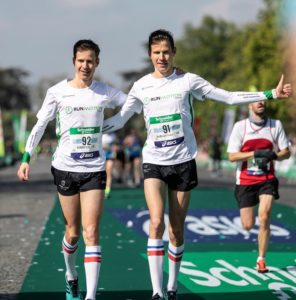
What do you think of Wetall?
I was delighted to discover this community where, at first, with my small height of 1m88, I didn’t think I fitted in, but my shoe size 48 allowed me to join this club! I appreciate the blog articles that let you discover incredible stories and get practical advice! Furthermore, featuring articles suited to tall people makes it easier to search for products that match our needs.
What to take from this, if you run in Britain
Five things, drawn from Guillaume’s answers and from what they mean on this side of the Channel.
- Count your cadence before you change anything else. A long, slow stride is the tall runner’s default fault and the cheapest one to fix.
- Use the three-times-body-weight figure to set your progression. The heavier you are, the slower you should add mileage, and that is a physics argument rather than a cautious one.
- Get off the pavement. Towpaths, bridleways and park loops are everywhere in this country and they cost your joints far less than roads.
- Learn to descend on something gentle. A high centre of gravity is the one disadvantage you cannot train away, only manage, and British hill running will expose it quickly.
- Order shoes early and buy two pairs when you find a model that fits. Above a UK 13, stock disappears and models get discontinued without warning.
Thank you Guillaume for these valuable tips.
More on Wetall
- The best sports for tall people, which sets running in context against rowing, rugby and the rest.
- Eating well when you’re tall, our interview with the dietitian Julien Rebeyrol.
- Should tall people squat, on the same long-lever problem applied to the gym.
- Large size shoes by international sizes, for the UK, EU and US conversions.
Sources
- Interview conducted by Wetall with Guillaume Adam. His answers are reproduced unchanged.
- World Athletics competition rules, 3000 m steeplechase barrier heights of 91.4 cm and 76.2 cm: worldathletics.org
- Roger Bannister’s sub-four-minute mile, Iffley Road, Oxford, 6 May 1954: olympics.com
- UK Wife Carrying Race, Dorking, Surrey, seventeenth edition in 2026: UPI
- parkrun, free timed 5 km events across the UK: parkrun.org.uk