
Height in tennis is usually discussed as a serving advantage and left there. It is more interesting than that, and the place where it becomes most interesting is a lawn in south-west London. Wimbledon is the only Grand Slam still played on grass, and grass is the surface that most rewards the one thing a very tall player does better than anyone, while punishing the thing he does worst.
The evidence is sitting in the list of the tallest men ever to play professional tennis. Work through it and a pattern appears: an unusual number of them produced the best Grand Slam result of their career at Wimbledon, and nowhere else. This article explains why, sets out what height costs on the same surface, and gives the ranking with the numbers checked.
What the serve actually gains from height
The serve is the only shot in tennis played from a standing start, with the player choosing the contact point. Height raises that contact point, and raising it changes the geometry of the shot.
A server has to clear the net and land the ball inside the service box. The higher the contact point, the steeper the angle available into the box, and the less the server has to rely on net clearance or spin to keep the ball in. At around 2.11 m with an arm raised, the contact point sits well above three metres. That opens trajectories a 1.80 m player cannot hit at all. It also lengthens the lever: a longer arm and a higher reach generate more racket head speed for the same shoulder rotation.
The second effect is harder to see and matters more. A ball served from higher up arrives at the receiver having dropped further, which means it arrives faster and at a flatter angle. The receiver has less time and a worse position from which to answer.
What the Wimbledon grass does to the ball
Grass is not simply fast. It is low. A ball on grass skids rather than grips, keeps most of its speed and, as the surface is usually described, rarely rises above knee height. That is the key fact for tall servers, and it is also the key fact for everything that goes wrong for them.
Wimbledon’s courts have been sown exclusively with perennial ryegrass since 2001, mown to 8 mm, and rolled flat so that the bounce is as consistent as a living surface allows. Fresh grass at the start of the fortnight gives the lowest, quickest bounce. By the second week the grass behind the baselines has worn through, the bounce climbs and slows, and the court begins to behave more like a hard court.
Put the two together. A serve struck from three metres up, landing on a surface that refuses to let the ball bounce back into the hitting zone, leaves the receiver playing from below the knee at close to full pace. On clay the same serve sits up and can be attacked. On the Wimbledon grass of the first week, very often, it cannot be returned at all.
The ten tallest men, and where each one peaked
This is the ranking, with each player’s single best Grand Slam singles result beside his height. Read the right-hand column rather than the left.
| Height | Player | Nationality | Best Grand Slam singles result |
|---|---|---|---|
| 2.11 m | Ivo Karlović | Croatia | Wimbledon quarter-final, 2009 |
| 2.11 m | Reilly Opelka | United States | US Open fourth round, 2021 |
| 2.08 m | John Isner | United States | Wimbledon semi-final, 2018 |
| 2.03 m | Jerzy Janowicz | Poland | Wimbledon semi-final, 2013 |
| 2.03 m | Kevin Anderson | South Africa | Wimbledon final, 2018 |
| 2.03 m | Dick Norman | Belgium | Wimbledon fourth round, 1995 |
| 2.01 m | Chris Guccione | Australia | No run beyond the early rounds |
| 2.01 m | Marc Rosset | Switzerland | French Open semi-final, 1996 |
| 1.98 m | Marin Čilić | Croatia | US Open champion, 2014 |
| 1.98 m | Daniil Medvedev | Russia | US Open champion, 2021 |
| 1.98 m | Juan Martín del Potro | Argentina | US Open champion, 2009 |
| 1.98 m | Sam Querrey | United States | Wimbledon semi-final, 2017 |
| 1.98 m | Victor Hănescu | Romania | French Open quarter-final, 2005 |
Of the six men above two metres, five recorded their best Slam at Wimbledon. Add Querrey’s 2017 semi-final and Čilić’s 2017 Wimbledon final, which sits alongside his US Open title, and the pattern is hard to put down to chance. The three who peaked elsewhere, Rosset, Medvedev and del Potro, are the three with the most complete games from the back of the court, which is the point: Wimbledon is where a player whose main asset is the serve gets closest to the trophy.
The men grass rewarded
Ivo Karlović, 2.11 m
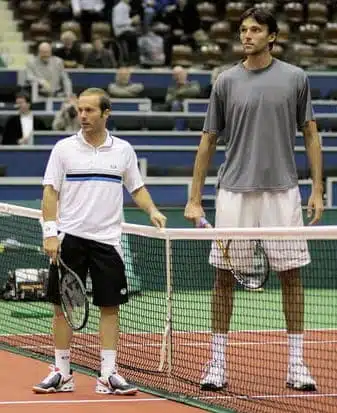
The Croatian’s career began at Wimbledon in the most abrupt way available. Ranked 203 in the world in 2003, playing his first Grand Slam match, he beat the defending champion Lleyton Hewitt in the first round. He went on to win eight ATP titles, reached No. 14 in August 2008, and held the career record for aces, 13,728 by September 2021, until John Isner passed it. His best Slam showing was the Wimbledon quarter-final of 2009. He retired in February 2024, aged 44, having not played since 2021.
John Isner, 2.08 m
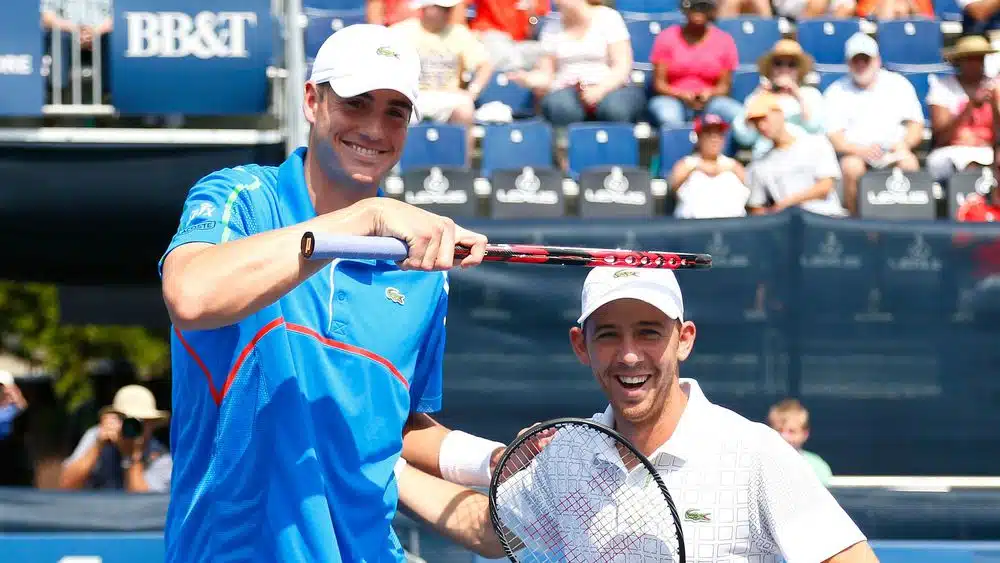
Sixteen ATP titles, a career high of No. 8 in July 2018, and a career ace total of 14,470 by the time he stopped, the most in tour history. He passed Karlović’s record during a third-round Wimbledon match against Jannik Sinner in 2022. His best Slam was the 2018 Wimbledon semi-final, and he retired on 1 September 2023. His name is attached to the two longest matches in Wimbledon history, which is the subject of the next section.
Kevin Anderson, 2.03 m
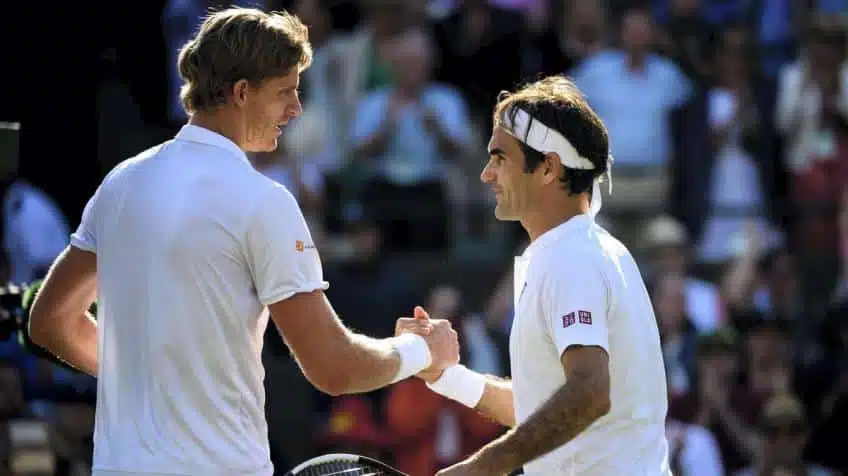
Born in Johannesburg, seven ATP titles, and two Grand Slam finals: the 2017 US Open, lost to Rafael Nadal, and Wimbledon 2018, lost to Novak Djokovic. The route to that Wimbledon final is the striking part. He beat Roger Federer in the quarter-final and Isner in the semi-final, and reached No. 5 in the world a few days later. He retired in May 2022 after a brief return the following year.
Jerzy Janowicz, 2.03 m
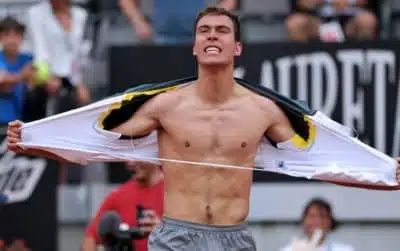
The Pole reached the Paris Masters final in 2012 and the Wimbledon semi-final in 2013, which remains the best Grand Slam run by a Polish man. Injury took the rest. His case is the cleanest version of the pattern: one deep run, on grass, and nothing comparable on any other surface.
Dick Norman, 2.03 m
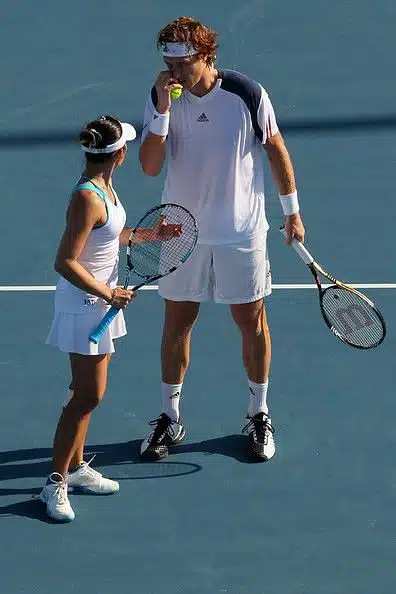
The Belgian’s Wimbledon of 1995 is worth more attention than it gets. He entered as a lucky loser, having failed to qualify, and then beat Pat Cash, Stefan Edberg and Todd Woodbridge before losing to Boris Becker in the fourth round. He never won an ATP singles title, but he did win four in doubles and reached No. 10 in the world doubles ranking in April 2010, which is a long way from winning nothing.
Sam Querrey, 1.98 m
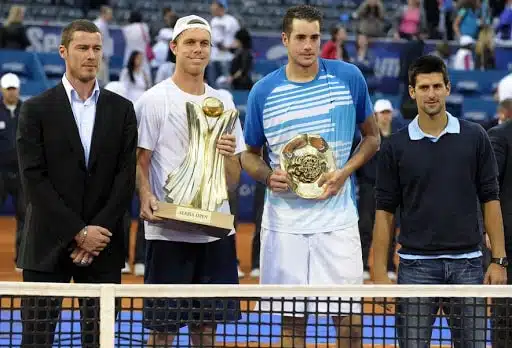
The American beat Novak Djokovic at Wimbledon in 2016, when Djokovic was holder of all four Slams, and reached the Wimbledon semi-final the following year, losing to Čilić. He won titles on all three surfaces, and his one deep Slam run came on grass.
Marin Čilić, 1.98 m
The most decorated of the group after Medvedev and del Potro. Eighteen ATP titles, the 2014 US Open, a career high of No. 3 in January 2018, and the 2017 Wimbledon final against Federer. He served a four-month suspension in 2013 after a positive test that an appeal panel accepted came from a contaminated over-the-counter supplement.
Two matches that changed the rules of Wimbledon
Height does not only decide who wins points on grass. Twice it has decided how the tournament is run.
In the first round of 2010, Isner and Nicolas Mahut played for 11 hours and 5 minutes across three days, the final set finishing 70-68. It remains the longest match in the history of the sport, and you can still watch the whole of it.
In the semi-final of 2018, Isner met Anderson: 2.08 m against 2.03 m, two of the biggest serves ever recorded, on grass. Anderson won 7-6(6), 6-7(5), 6-7(9), 6-4, 26-24, in 6 hours and 36 minutes. Ninety-nine games, 569 points, 102 aces between them. It is the second-longest match ever played at Wimbledon, and it ran so long that the Djokovic and Nadal semi-final that followed had to be suspended under the local curfew.
That was the end of the All England Club’s patience. In October 2018 the chairman, Philip Brook, announced that from 2019 a tiebreak would be played at 12-12 in the deciding set. The tournament had resisted the change for decades. Two very tall men serving at each other for thirteen hours across eight years ended the argument.
What height costs on the same lawn
The low bounce that makes a tall player’s serve unreturnable also makes his return of serve harder than anyone else’s. A ball that stays below knee height has to be met with the knees bent and the centre of gravity dropped, and the further a player’s shoulders are from the ground, the further they have to travel to get there. Every low ball is a bigger movement for a tall player, and grass produces more low balls than any other surface.
Footing is the second cost. Grass is slick, especially in the first days and after rain, and changing direction on it demands a low, braced stance. A high centre of gravity is a disadvantage in exactly that movement. Players at this height also carry more load through the knees, hips and lower back for every stop and start, which is one reason the list above is full of careers shortened by injury rather than by age. Reilly Opelka, the youngest man in the ranking, has lost roughly two and a half years of his career to a wrist problem and then a back problem.
The reason the trade-off still favours height at Wimbledon is simply that grass shortens points. Fewer rallies means fewer low balls to dig out and fewer changes of direction. The surface hands a tall player his best weapon and then limits the number of times he has to expose his worst.
The men grass did not reward
Juan Martín del Potro, 1.98 m
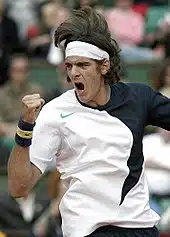
Twenty-two titles, the 2009 US Open, the Davis Cup in 2016, Olympic silver and bronze, and No. 3 in the world in August 2018. His weapon was a forehand, not a serve, and his best work was done on hard courts. Wrist surgery, four operations in all, cost him years.
Daniil Medvedev, 1.98 m
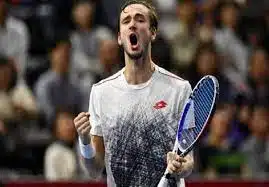
The most successful player ever to appear in a list of this kind. Twenty-three ATP titles, six Masters 1000s, the 2021 US Open, beating Djokovic in the final, and world No. 1 from 28 February 2022. He was ranked No. 8 in August 2026. He has reached the Wimbledon semi-final twice, in 2023 and 2024, but his game is built for hard courts: he defends from far behind the baseline, which grass does not allow.
Marc Rosset, 2.01 m
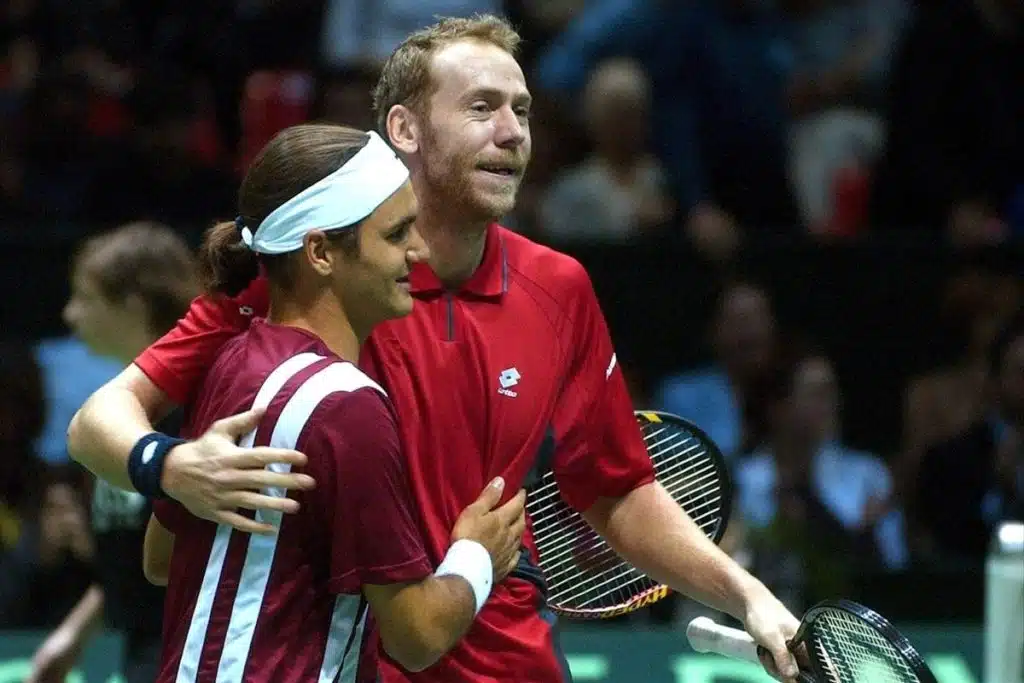
Fifteen singles titles, No. 9 in the world in September 1995, and Switzerland’s first Olympic tennis champion, winning the Barcelona gold in 1992 by beating Jordi Arrese in five sets. It is worth noting that the Barcelona tennis was played on clay, not grass, and his best Slam was the French Open semi-final of 1996. Rosset is the counter-example in the list: a very tall man whose best tennis came on slow surfaces.
Chris Guccione, 2.01 m
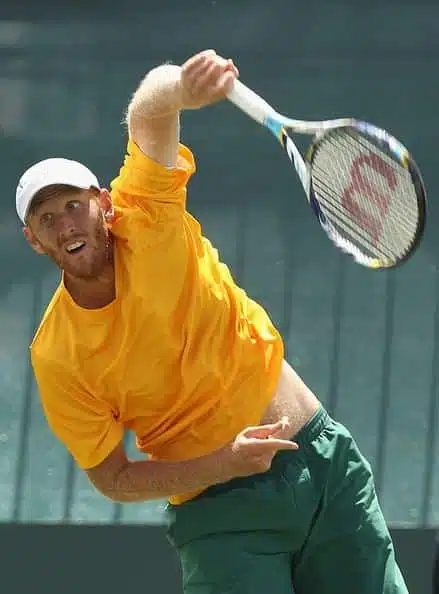
The Australian had one of the biggest left-handed serves of his era and built a better doubles career than singles career on it. A figure of 248 km/h circulates for his fastest serve, said at the time to be within a couple of kilometres per hour of the world record. We have not been able to trace that measurement to an ATP-ratified source, so treat it as reported rather than established. The verified numbers are in the section below.
Victor Hănescu, 1.98 m
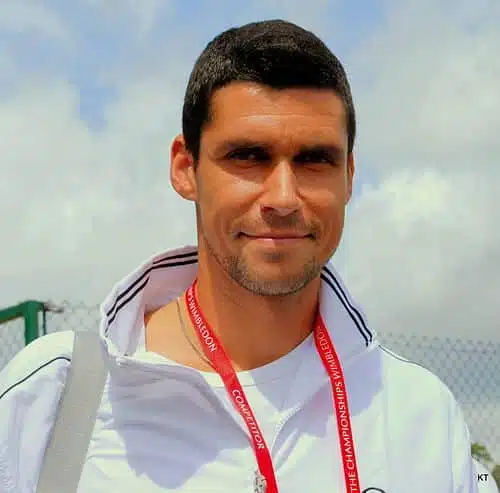
A Romanian professional from 2000 to 2016, one ATP singles title and two in doubles, a career high of No. 26 in July 2009, and a French Open quarter-final in 2005, lost to Federer. His one appearance in Wimbledon’s history is an unhappy one. In the third round of 2010, taunted by a section of the crowd, he spat in their direction, deliberately served foot faults to hand his opponent a 3-0 lead in the final set, and retired from the match. Four spectators were arrested; he was fined 15,000 US dollars. It is the only incident of its kind in this ranking, and it happened on the surface that suited him least.
Reilly Opelka, 2.11 m
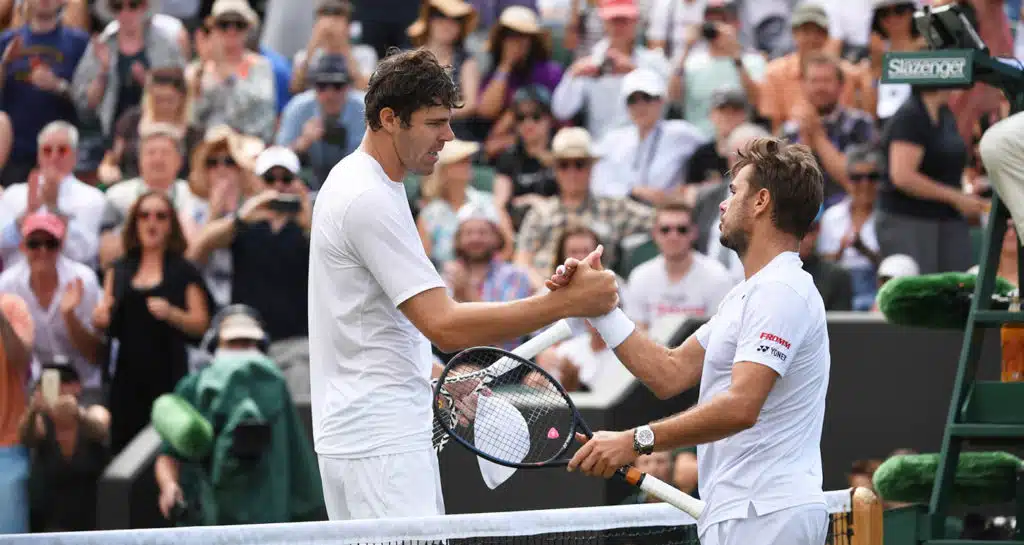
Equal tallest in the ranking with Karlović, and the only one of the two still playing. Four ATP singles titles, a career high of No. 17 in February 2022, and a best Slam result of the fourth round at the 2021 US Open. At Wimbledon his best is the third round, in 2019, where he beat Stan Wawrinka. He was ranked 102 in June 2026 after long absences for a wrist injury and then a back problem. He is also the clearest illustration that height is not a career plan: the body gives out before the serve does.
The serve speed records, corrected
The fastest serve figures attached to these players circulate in a confused state, so here is where they actually stand.
| Serve | Player | Event | Status |
|---|---|---|---|
| 263.4 km/h | Sam Groth | Busan Challenger, 2012 | Fastest ever recorded; not recognised by the ATP as a tour-level record |
| 254.3 km/h | Ben Shelton | US Open semi-final, 2026 | Fastest at an ATP main-tour event |
| 253 km/h | John Isner | Davis Cup, 2016 | Long cited as the record; now surpassed |
| 251 km/h | Ivo Karlović | Davis Cup doubles, 2011 | Record until Isner passed it in 2016 |
| 246.2 km/h | Giovanni Mpetshi Perricard | Wimbledon first round, 2025 | Fastest serve recorded at Wimbledon |
Two things stand out. Isner no longer holds the record, which is still widely stated as though he does. And the fastest second serve on record, 237 km/h, was also struck by Mpetshi Perricard at Wimbledon in 2025, on the surface where the reward for a flat, skidding ball is highest.
The tallest women, with a Stockport name near the top
The women’s list is shorter and the reporting around it is less reliable. These are the heights as published, and two of them disagree with each other.
| Height | Player | Nationality | Best record |
|---|---|---|---|
| 1.91 m | Eva Hrdinová | Czech Republic | Mainly ITF circuit, five finals |
| 1.90 m | Akgul Amanmuradova | Uzbekistan | Two WTA doubles titles; No. 50 in singles, 2008 |
| 1.89 m | Naomi Broady | Great Britain | One WTA doubles title; No. 76 in singles, 2016 |
| 1.89 m | Lindsay Davenport | United States | Three Grand Slams; 98 weeks at No. 1 |
| 1.88 m | Maria Sharapova | Russia | All four Grand Slams; Olympic silver |
Hrdinová is usually named as the tallest woman ever to play professionally, at 1.91 m. Amanmuradova is listed at 1.90 m by the WTA and at 1.91 m by some other databases, which would make them equal. We have not found a measurement that settles it.
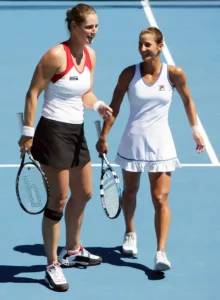
Hrdinová spent her career mostly on the ITF circuit and reached five finals there. Amanmuradova won two WTA doubles titles, reached No. 50 in singles in May 2008 and No. 36 in doubles in January 2010, and her best Grand Slam singles results were third rounds at the 2010 French Open and the 2011 US Open.
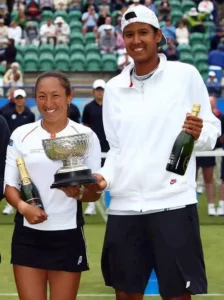
The British name in the list is Naomi Broady, 1.89 m, born in Stockport. She reached No. 76 in singles in March 2016 and No. 56 in doubles in May 2017, and won the Monterrey Open doubles title in 2018 with Sara Sorribes Tormo. At Wimbledon her best singles result was the second round in 2014, with a third round in doubles in 2016 and two mixed doubles quarter-finals, in 2014 and 2021. She retired in 2021. Her brother Liam Broady also plays professionally.
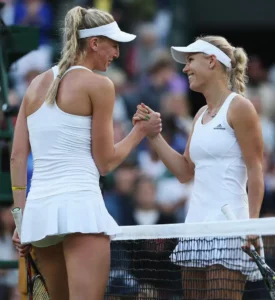
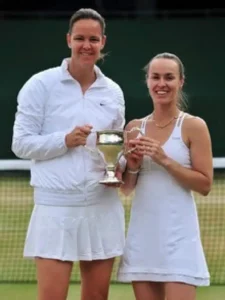
Davenport has by far the best record of the five: 55 singles titles, 38 in doubles, three Grand Slams, three Fed Cups, Olympic gold, and 98 weeks as world No. 1. She was also a genuinely tall player who won on every surface, including a Wimbledon title in 1999.
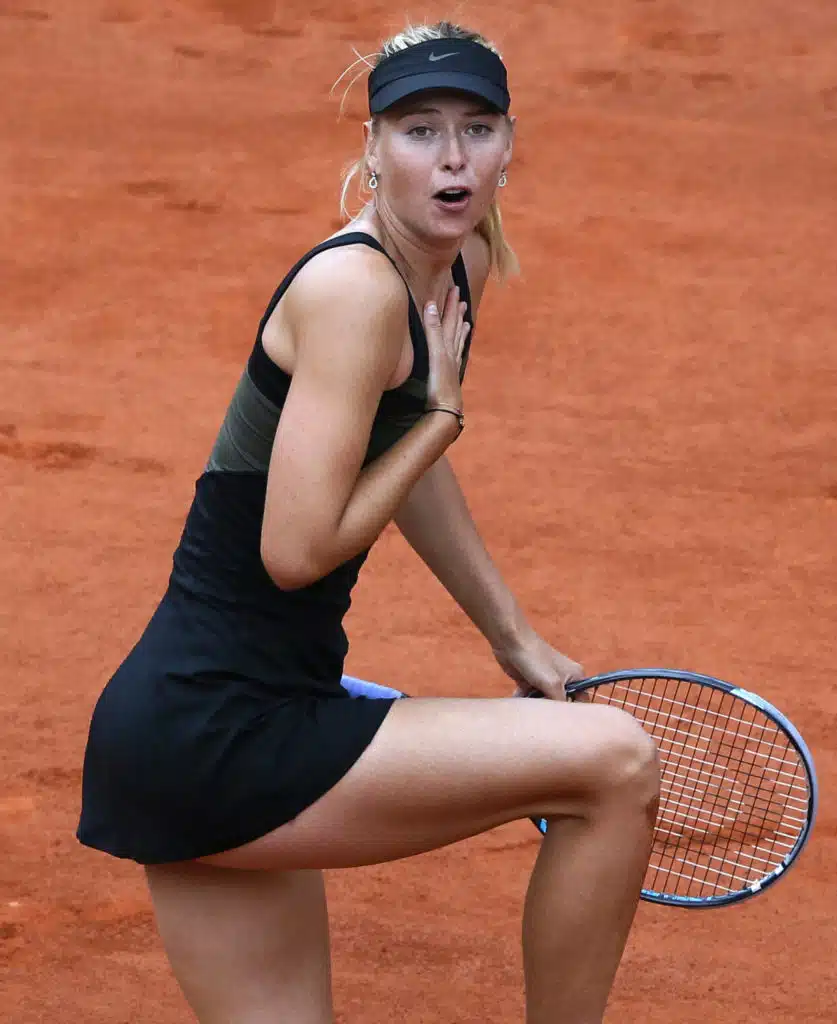
Sharapova, born in Siberia, won 36 singles titles and all four Grand Slams, two of them at the French Open, plus an Olympic silver medal. Her first Grand Slam title, at 17, was Wimbledon in 2004.
Britain hosts the grass Slam and does not produce giants
Here is the oddity. The country that owns the surface on which height pays best has produced almost nobody tall enough to exploit it. The tallest British player in either list above is a woman, Naomi Broady at 1.89 m.
On the men’s side, Britain’s two Wimbledon singles champions of the modern era, Andy Murray at 1.90 m, and before him the near-misses of Tim Henman at 1.85 m, were mid-sized players who won on movement and touch. The current British No. 1, Jack Draper, is 1.93 m, born in Sutton and raised in Ashtead. He reached No. 4 in the world in June 2025 and has won three ATP titles including Indian Wells, and his best Wimbledon result is the second round. He withdrew from the 2026 Championships with an arm injury, one of a long run of them.
The most promising tall British prospect is Henry Searle of Wolverhampton, also 1.93 m, who won the Wimbledon boys’ singles title in 2023, the first British winner of it for 61 years, since Stanley Matthews in 1962. He was recorded serving at 129 mph during that run.
None of these men is tall by the standards of the table at the top of this page. If you are reading this because you are tall and play tennis in Britain, that is the useful finding: the surface is on your side, and the competition for it at home is thinner than it should be.
Where this leaves height in tennis
Height does not win tennis matches on its own. The two best players in the tallest-men list, Medvedev and del Potro, succeeded on hard courts with complete groundstroke games, and the one player in it who reached world No. 1 did it from a baseline position grass makes untenable. Height with nothing attached to it produces Guccione’s career, not Čilić’s.
But on 8 mm of perennial ryegrass in the first week of a Wimbledon fortnight, height is worth more than it is anywhere else in the sport, and the record shows it. Five of the six men above two metres never got as far at any other Slam as they got on that lawn. Two of them kept the All England Club on court long enough to change its rules.
If you want to read further on the body mechanics behind this, we have covered which sports actually suit tall people and whether tall people should squat, which deals with the same centre-of-gravity problem that makes low balls hard. For the other end of the sporting scale, see the tallest basketball players in the world and the tallest footballers of all time. And for the limits of the human frame, there is the tallest men of all time.
Sources
- Grass court: playing characteristics
- How the courts at Wimbledon are groomed: perennial ryegrass, 8 mm cut
- NBC Sports: Anderson beats Isner in the second-longest Wimbledon match
- Tennis Now: Wimbledon announces the 12-12 final-set tiebreak
- Sports Mole: the five longest matches in Wimbledon history
- Fastest recorded tennis serves, with ratification status
- Ivo Karlović: career record and ace total
- John Isner: career record, ace record and retirement
- Kevin Anderson: Grand Slam finals and career high
- Dick Norman: the 1995 Wimbledon run and doubles record
- Marc Rosset: 1992 Olympic gold and career record
- Daniil Medvedev: titles, No. 1 ranking and Wimbledon record
- Victor Hănescu: career record and the 2010 Wimbledon incident
- Reilly Opelka: titles, ranking and injury history
- Naomi Broady: height, titles and Wimbledon record
- Akgul Amanmuradova: height and career record
- Jack Draper: height, ranking and Wimbledon record
- LTA: Henry Searle, first British boys’ singles champion for 61 years