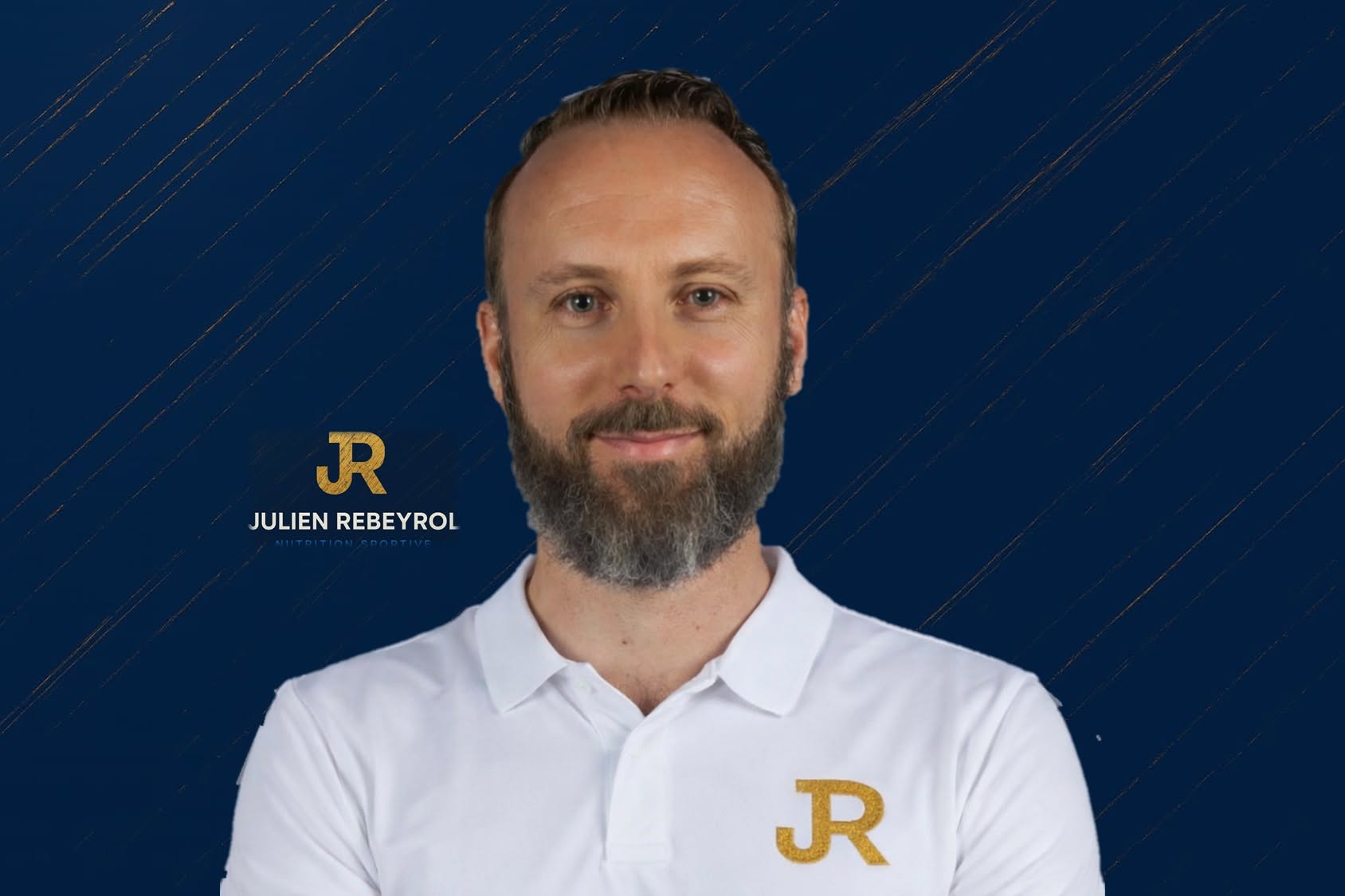
Julien Rebeyrol is a dietitian-nutritionist in Lyon who has spent seven seasons feeding a professional rugby squad and several more looking after two basketball teams, including a season with Victor Wembanyama. We asked him what changes about food when a body is very tall. His answer, repeated in several different ways across ten questions, was that almost nothing does, and that the question most tall people ask is the wrong one.
His replies below are reproduced word for word, as he gave them. We have not rewritten a single sentence of them. What we have added is the part a British reader needs and which a French interview cannot supply on its own: what his warning about unqualified practitioners means on this side of the Channel, where the law draws the line differently, and which register to check before you hand anyone money.
Who he is
We asked him to introduce himself.
Hello, I’m Julien Rebeyrol, a dietitian-nutritionist for over 10 years, specialising in sports nutrition. I’m based in Lyon in charge of nutritional support for LOU Rugby for 7 seasons. I also provide follow-ups with the men’s and women’s basketball teams at ASVEL where I had the opportunity to follow in particular Victor Wembanyama, Nando de Colo and Héléna Ciak. I also consult at the Paul SANTY paramedical centre in Lyon.
I hold a DUT in biological engineering with a dietetics option as well as a Postgraduate Diploma in sports nutrition. Previously I had obtained a STAPS degree in coaching and a master’s in physical preparation.
I also teach at university where I give sports nutrition lectures and give talks in clubs or with the SFNS-French society for sports nutrition.
Two of those qualifications have no exact British equivalent. The DUT is a two-year technical diploma and STAPS is the French university route into sport science. The structure matters less than the point he makes next, which is the one that transfers.
Dietitian or nutritionist, and why the answer is different in Britain
We asked him what separates the two titles.
Either you are a dietitian-nutritionist or you are a doctor nutritionist. Outside of these two designations, people practise without a diploma.
A simple “nutritionist” or “nutrition officer” has no diploma to practise. You must therefore be extremely cautious.
The internet and especially social media are full of incredible nonsense when it comes to nutrition. It is vital for your health not to believe everything you read. Those who wish real nutritional advice should see a dietitian, everything else is not scientific.
His advice is right. His map is French. In the United Kingdom the line falls in a slightly different place, and if you follow his instruction literally you will still end up with a qualified person, but you may also reject someone who is perfectly well qualified.
Here, dietitian is the only nutrition title with statutory protection. The British Dietetic Association states that you must be registered with the Health and Care Professions Council to use it, after an accredited degree or apprenticeship that includes 1,000 hours of supervised practice. Using the title without that registration is a criminal matter, not a matter of taste.
Registered Nutritionist, or RNutr, is regulated too, but voluntarily. It belongs to people on the UK Voluntary Register of Nutritionists, held by the Association for Nutrition, which requires an accredited nutrition science degree and three or more years of evidenced practice. That is a real qualification, and it has no clean French equivalent, which is why Rebeyrol’s two-category answer does not quite cover it.
Nutritionist on its own, and nutrition consultant, and diet expert, are regulated by nobody at all. Anybody may print them on a card. That is the category Rebeyrol is warning you about, and in Britain the warning is if anything stronger, because the unprotected word here looks almost identical to the protected one.
| Title | Status in the UK | Who holds the register |
|---|---|---|
| Dietitian (RD) | Protected by law | Health and Care Professions Council |
| Registered Nutritionist (RNutr) | Voluntary register | Association for Nutrition |
| Registered nutritional therapist | Voluntary register, complementary practice | Complementary and Natural Healthcare Council |
| Nutritionist, nutrition coach, diet expert | Not regulated | Nobody |
For sport specifically there is a fourth register, and it is the one worth knowing if you train seriously. The Sport and Exercise Nutrition Register, run by the British Dietetic Association, lists practitioners at two levels: Graduate, for people with the qualifications but not yet the two to three years of practice, and Practitioner, for those whose casework has been assessed against the full competency framework. Its directory is public. Rebeyrol’s French equivalent is the SFNS he mentions; the register is the British version of the same idea.
Does he actually see very tall athletes?
Absolutely. Because of my work at the LOU Rugby professional club, I see very strong builds, some even exceed 2m like Romain Taofifenua at 2m03 for 135kg. The same with Victor Wembanyama who is over 2m22.
Despite my 1m80 I seem small at ASVEL or at LOU!
British rugby produces the same bodies. The tallest active English Premiership player recognised by Guinness World Records is Will Carrick-Smith, measured at 2.11 m while at Exeter Chiefs, a record dated 2015 and which Guinness itself flags as the sort of entry that goes out of date without being updated online. Our guide to the best sports for tall people, and why height helps in them covers where that build is an advantage and where it is a liability.
What changes nutritionally when you are tall
This is the question the article exists to answer, and his reply is blunt.
In reality, there aren’t any. Height does not impact the athlete’s nutrition. It is the weight due to this height that will impact it.
At equal expenditure, whether the athlete is 2m10 or 1m95, if in both cases they weigh 105kg the differences in energy requirements will not be so different: in short, weight impacts needs more than height.
We can still see specific features on extremely tall cases like with Victor when he played at ASVEL
Worth reading twice, because it contradicts most of what gets written for tall readers. Height is not a nutritional category. Mass is. A 2.10 m man at 105 kg and a 1.95 m man at 105 kg are, for the purposes of a daily intake, close to the same problem. What height does is make a given mass easier to carry and harder to reach, which is a different conversation.
He leaves himself one exception, and does not elaborate on it: the extreme cases. At 2.22 m and above, surface area, joint loading and simple appetite start to behave differently, and the honest answer is that there is very little published work on bodies that rare.
What a tall athlete should watch
Nothing more than a person of different height. You need to pay attention to your needs in lipids, proteins and carbohydrates rather than your calories. You also need to be supported by a dietitian if you have serious goals.
General advice for tall people
Nothing more than those of different height. As mentioned above, it is mainly the person’s weight that will determine what they eat.
Losing weight when you are tall
I repeat but these are the same as for those of shorter height.
You need to stop eliminating fat and stop eliminating starchy foods in the evening. These are clichés. In the same way, fat is not bad, quite the opposite.
It is above all about listening to food sensations, that’s what’s most important.
I also recommend real support and follow-up by a qualified dietitian.
Remember well that no food makes you gain or lose weight, it’s all a question of context, hunger sensation and achieving satiety.
The two clichés he names are both current in Britain. The evening carbohydrate rule in particular survives in gym culture here with no evidence behind it. The NHS Eatwell Guide, which is the official British reference for a general population diet, places starchy carbohydrates at just over a third of the plate and attaches no time of day to them.
Gaining muscle
The same as for other heights. You must first adjust macronutrient intake based on weight. Then you need to adjust your food intake according to your training sessions (training or competition). And finally you need to adjust the number of meals you have during the day.
Note the order: mass first, then the training calendar, then meal frequency. Meal frequency is last on his list and first in most online advice. If you are also lifting, our piece on whether tall people should squat deals with the mechanical side of the same problem.
Apps and body composition scales
We asked him for a final practical answer on daily tracking.
Definitely not an app! It’s a vector of eating disorder because it produces a need based on a flawed algorithm which is the opposite of sensations. The same goes for scales, it’s pointless, we don’t measure felt temperature based on the clothes we have. You need to base yourself on intuition based on our sensations.
As part of a programme, go and see a dietitian. Most athletes using apps can drift towards eating disorder.
Some athletes were doing Instagram challenges and ended up in poor health situations. It was detrimental to their careers.
Regarding impedance scales it’s nonsense for several reasons. First, most models don’t have handles and therefore don’t allow logical circulation of the tension needed to analyse body composition. Then, these scales aren’t super reliable. And finally, because the results can be biased depending on the water present in the body. So completely pointless. It’s best to use medical devices with real validity, which is not the case with this type of scale.
This is the answer with the sharpest British context. Since April 2022, large businesses in England with 250 or more employees have been required to display calorie information at the point of choice, on menus, online ordering and delivery platforms. The policy was announced in May 2021 and arrived over the objections of eating disorder charities. Beat, the UK charity, has made the same argument Rebeyrol makes here about tracking tools in general: its director of external affairs, Tom Quinn, said of a government incentive app trialled in Wolverhampton in December 2021 that it had the potential to be, in his words, incredibly damaging to people with eating disorders.
We would add one caveat to his position, because he overstates a part of it. Bioelectrical impedance is not useless; it is unreliable at the individual level and sensitive to hydration, which is a narrower complaint. Hand-to-foot devices with handles do read more of the body than foot-only bathroom scales. The practical conclusion is the same as his, though: a single reading on a consumer scale tells you almost nothing, and for a very tall person the normative data the device compares you against barely exists.
What he thinks of Wetall
It’s great because tall people often feel set apart and abandoned, their specific needs are not sufficiently taken into account and Wetall helps. Tall people now feel less isolated.
We tend to better understand a person in an obese situation whereas a thin-built person will experience the same suffering as them, for tall people it’s the same we don’t always see the negative aspects of being tall, and for that Wetall helps a lot.
See you soon!
What the interview does not settle
Three things, and it is fairer to say so than to pretend otherwise.
- He gives no numbers. There is no gram-per-kilogram figure anywhere in his answers, deliberately, because he thinks the figure is the wrong thing to chase. If you want one, you need the individual assessment he keeps recommending.
- He works with professional athletes. A 2.00 m reader who sits at a desk has a different energy budget from a 2.03 m second row at 135 kg, and the advice to stop counting calories reads differently in each case.
- Nothing here is specific to British food supply, portion conventions or the practical problem of buying enough food on a normal budget when you need more of it than everyone around you.
If you are tall and training, the one instruction from this interview worth acting on is the dullest one: check the register before you check the advice. In Britain that means the HCPC for a dietitian, the Association for Nutrition for an RNutr, and the Sport and Exercise Nutrition Register if the work is athletic. Related reading on this site: running when you’re tall, a coach’s answers with the British detail, and which country has the tallest average height, and where Britain sits.
Thank you
Our thanks to Julien Rebeyrol for the exchange, and for answering the question we asked rather than the one we expected.
Sources
- British Dietetic Association, “What are the differences between dietitians and nutritionists?”, for the HCPC protection of the dietitian title, the 1,000 supervised hours, the UKVRN and RNutr, the CNHC and the unregulated titles.
- Sport and Exercise Nutrition Register, routes to registration, for the Graduate and Practitioner levels and the competency framework.
- Guinness World Records, “Tallest active English Premiership rugby union player”, for Will Carrick-Smith at 2.11 m, Exeter Chiefs, 2015, and for the warning that the entry may be out of date.
- GOV.UK, “Calorie labelling on menus to be introduced in cafes, restaurants and takeaways”, 12 May 2021, for the April 2022 start and the 250-employee threshold.
- HTWorld, “UK government’s health app could be incredibly damaging to people with eating disorders”, 4 December 2021, for the quotation from Tom Quinn of Beat.
- NHS, the Eatwell Guide, for the place of starchy carbohydrates in the official British reference diet.
References supplied by Julien Rebeyrol with his answers
- Centre Paul Santy, dietetics team
- Société française de nutrition du sport
- Gravel K, Tribole E and Resch E. Intuitive Eating, 4th Edition: A Revolutionary Anti-Diet Approach. St. Martin’s Essentials, 2020
- American Dietetic Association, Dietitians of Canada, American College of Sports Medicine; Rodriguez NR, Di Marco NM, Langley S. American College of Sports Medicine position stand. Nutrition and athletic performance. Med Sci Sports Exerc. 2009 Mar;41(3):709-31. PMID 19225360
- Mountjoy M, Sundgot-Borgen J, Burke L, Carter S, Constantini N, Lebrun C, Meyer N, Sherman R, Steffen K, Budgett R, Ljungqvist A, Ackerman K. RED-S CAT. Relative Energy Deficiency in Sport (RED-S) Clinical Assessment Tool. Br J Sports Med. 2015 Apr;49(7):421-3. PMID 25896450
- Collins J, et al. UEFA expert group statement on nutrition in elite football. Br J Sports Med. 2020;0:1-27